Readings Newsletter
Become a Readings Member to make your shopping experience even easier.
Sign in or sign up for free!
You’re not far away from qualifying for FREE standard shipping within Australia
You’ve qualified for FREE standard shipping within Australia
The cart is loading…


This title is printed to order. This book may have been self-published. If so, we cannot guarantee the quality of the content. In the main most books will have gone through the editing process however some may not. We therefore suggest that you be aware of this before ordering this book. If in doubt check either the author or publisher’s details as we are unable to accept any returns unless they are faulty. Please contact us if you have any questions.
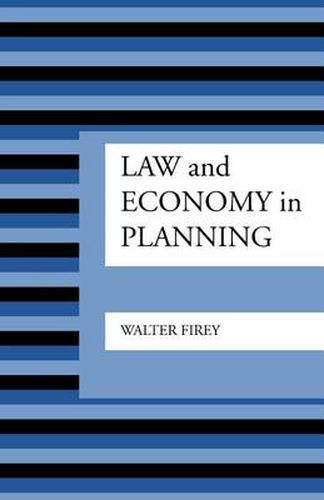
From the beginnings of human association, social planning has been an accepted method for effecting improvements in community, regional, and national life. In Law and Economy in Planning, Walter Firey has made a start in the development of an intellectual framework that will give meaning to the craft of planning and establish a relationship between practice and first principles. In this study he investigates basic elements of this framework existing in two normative orders: the state, in which a collectivity has the obligation to enforce obedience; and the market, in which the individual has the right to be rational. These normative orders, whose laws are formulated in the disciplines of jurisprudence and economics, have a common concern with the utilization of scarce means to given ends. These orders, the state and the market, are formulated by the art of planning and have a common relationship to the natural order, which cannot be planned, but only predicted, and which is explained by the science of planning. To bridge the gap between the natural order and the normative order is the function of a philosophy of planning, for which an intellectual framework-of necessity interdisciplinary-is essential. This study is the culmination of several years of research in the fields of planning and social theory. During the course of this research Firey came to appreciate more and more keenly the need for an interdisciplinary formulation of the planning process and, with this, the need for a philosophical foundation for interdisciplinary work. A year’s fellowship at the Center for Advanced Study in the Behavioral Sciences at Stanford gave him the opportunity to develop his ideas bearing on this subject and to put them in writing.
$9.00 standard shipping within Australia
FREE standard shipping within Australia for orders over $100.00
Express & International shipping calculated at checkout
Stock availability can be subject to change without notice. We recommend calling the shop or contacting our online team to check availability of low stock items. Please see our Shopping Online page for more details.
This title is printed to order. This book may have been self-published. If so, we cannot guarantee the quality of the content. In the main most books will have gone through the editing process however some may not. We therefore suggest that you be aware of this before ordering this book. If in doubt check either the author or publisher’s details as we are unable to accept any returns unless they are faulty. Please contact us if you have any questions.
From the beginnings of human association, social planning has been an accepted method for effecting improvements in community, regional, and national life. In Law and Economy in Planning, Walter Firey has made a start in the development of an intellectual framework that will give meaning to the craft of planning and establish a relationship between practice and first principles. In this study he investigates basic elements of this framework existing in two normative orders: the state, in which a collectivity has the obligation to enforce obedience; and the market, in which the individual has the right to be rational. These normative orders, whose laws are formulated in the disciplines of jurisprudence and economics, have a common concern with the utilization of scarce means to given ends. These orders, the state and the market, are formulated by the art of planning and have a common relationship to the natural order, which cannot be planned, but only predicted, and which is explained by the science of planning. To bridge the gap between the natural order and the normative order is the function of a philosophy of planning, for which an intellectual framework-of necessity interdisciplinary-is essential. This study is the culmination of several years of research in the fields of planning and social theory. During the course of this research Firey came to appreciate more and more keenly the need for an interdisciplinary formulation of the planning process and, with this, the need for a philosophical foundation for interdisciplinary work. A year’s fellowship at the Center for Advanced Study in the Behavioral Sciences at Stanford gave him the opportunity to develop his ideas bearing on this subject and to put them in writing.
Search our extensive online catalogue.
