Readings Newsletter
Become a Readings Member to make your shopping experience even easier.
Sign in or sign up for free!
You’re not far away from qualifying for FREE standard shipping within Australia
You’ve qualified for FREE standard shipping within Australia
The cart is loading…


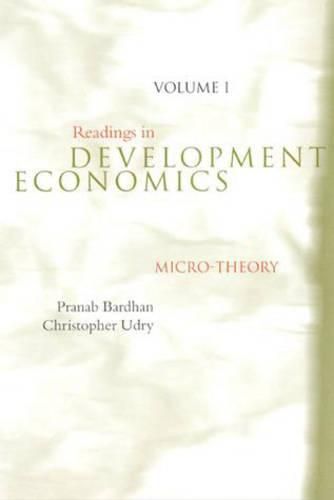
These two volumes of readings attempt to bring some degree of structure to a relatively diffuse field. Because of the sheer volume of high-quality work in development economics research, they are intended as a sampling of work at the frontier of the field, rather than as a comprehensive overview. Volume 1: Micro-Theory focuses on theoretical work. Topics covered include sharecropping as a principle-agent problem, fragmented duopolies, credit market imperfections, poverty traps, peer monitoring in credit cooperatives, coordination failures, human capital accumulation as an engine of growth and environmental issues in development. Volume 2: Emprirical Microeconomics focuses on empirical work. Topics covered include the relationship between wages and health, the role of human capital and demographic change, the internal structure of households, information imperfections in factor markets, the permanent income hypothesis, the possibility of Pareto-efficient allocation of risk in villages, and the relationship between property rights and investment decisions.
$9.00 standard shipping within Australia
FREE standard shipping within Australia for orders over $100.00
Express & International shipping calculated at checkout
Stock availability can be subject to change without notice. We recommend calling the shop or contacting our online team to check availability of low stock items. Please see our Shopping Online page for more details.
These two volumes of readings attempt to bring some degree of structure to a relatively diffuse field. Because of the sheer volume of high-quality work in development economics research, they are intended as a sampling of work at the frontier of the field, rather than as a comprehensive overview. Volume 1: Micro-Theory focuses on theoretical work. Topics covered include sharecropping as a principle-agent problem, fragmented duopolies, credit market imperfections, poverty traps, peer monitoring in credit cooperatives, coordination failures, human capital accumulation as an engine of growth and environmental issues in development. Volume 2: Emprirical Microeconomics focuses on empirical work. Topics covered include the relationship between wages and health, the role of human capital and demographic change, the internal structure of households, information imperfections in factor markets, the permanent income hypothesis, the possibility of Pareto-efficient allocation of risk in villages, and the relationship between property rights and investment decisions.
Search our extensive online catalogue.
