Readings Newsletter
Become a Readings Member to make your shopping experience even easier.
Sign in or sign up for free!
You’re not far away from qualifying for FREE standard shipping within Australia
You’ve qualified for FREE standard shipping within Australia
The cart is loading…


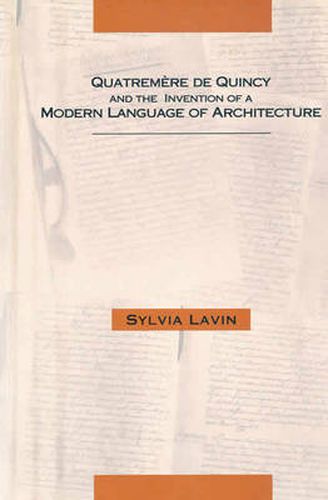
Sylvia Lavin uncovers the origins of one of the fundamental concepts of modern architectural theory, the idea that architecture is a form of language.
In this important revisionist work, Sylvia Lavin uncovers the origins of one of the fundamental concepts of modern architectural theory, the idea that architecture is a form of language. She demonstrates how, in some little-studied texts, the late Enlightenment theorist Quatremere de Quincy transformed a simple metaphor into a framework for reconceptualizing the structure of architecture. Lavin’s effort to interpret Quatremere in the context of intellectual history permits a deeper understanding of this controversial figure. More importantly, by focusing on the conceptual structure rather than the material illustrations of an architectural idea, she suggests a valuable new approach to the study of theories of architecture.
Lavin suggests that by using language to provide architecture with a conventional rather than natural model, Quatremere equated architecture’s capacity for progressive development with its sociality. Challenging the usual appraisal of Quatremere as a conservative academic, Lavin argues that his underlying emphasis on the social contract of architecture, rather than the neoclassical style he explicitly promulgated, is the key to the persistent interest in his writings. She shows how Quatremere’s effort to establish a universally valid theory of architecture led him beyond the boundaries of academic classicism and into contemporary developments in language theory, ethnography, and Egyptology.
Lavin then demonstrates how the relativism of these emerging spheres of knowledge, which sought to discover fundamental relationships between distinct cultural traditions, affected Quatremere’s understanding of architecture. She posits Quatremere as the first thinker to develop a theory of architecture able to accommodate a wide range of formal expressions and generate dissimilar discourses. In the process, she reveals a consonance between the interdisciplinary nature of his thought and the extraordinary breadth of his influence.
$9.00 standard shipping within Australia
FREE standard shipping within Australia for orders over $100.00
Express & International shipping calculated at checkout
Stock availability can be subject to change without notice. We recommend calling the shop or contacting our online team to check availability of low stock items. Please see our Shopping Online page for more details.
Sylvia Lavin uncovers the origins of one of the fundamental concepts of modern architectural theory, the idea that architecture is a form of language.
In this important revisionist work, Sylvia Lavin uncovers the origins of one of the fundamental concepts of modern architectural theory, the idea that architecture is a form of language. She demonstrates how, in some little-studied texts, the late Enlightenment theorist Quatremere de Quincy transformed a simple metaphor into a framework for reconceptualizing the structure of architecture. Lavin’s effort to interpret Quatremere in the context of intellectual history permits a deeper understanding of this controversial figure. More importantly, by focusing on the conceptual structure rather than the material illustrations of an architectural idea, she suggests a valuable new approach to the study of theories of architecture.
Lavin suggests that by using language to provide architecture with a conventional rather than natural model, Quatremere equated architecture’s capacity for progressive development with its sociality. Challenging the usual appraisal of Quatremere as a conservative academic, Lavin argues that his underlying emphasis on the social contract of architecture, rather than the neoclassical style he explicitly promulgated, is the key to the persistent interest in his writings. She shows how Quatremere’s effort to establish a universally valid theory of architecture led him beyond the boundaries of academic classicism and into contemporary developments in language theory, ethnography, and Egyptology.
Lavin then demonstrates how the relativism of these emerging spheres of knowledge, which sought to discover fundamental relationships between distinct cultural traditions, affected Quatremere’s understanding of architecture. She posits Quatremere as the first thinker to develop a theory of architecture able to accommodate a wide range of formal expressions and generate dissimilar discourses. In the process, she reveals a consonance between the interdisciplinary nature of his thought and the extraordinary breadth of his influence.
Search our extensive online catalogue.
