Readings Newsletter
Become a Readings Member to make your shopping experience even easier.
Sign in or sign up for free!
You’re not far away from qualifying for FREE standard shipping within Australia
You’ve qualified for FREE standard shipping within Australia
The cart is loading…


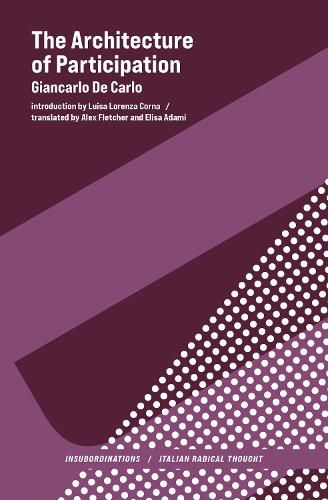
Seminal texts by renowned Italian architect Giancarlo De Carlo on architecture, education, and anarchy.
Giancarlo De Carlo's academic and professional career combined two seemingly opposed terms in a single vocation: architecture and anarchy. But this was a vocation that avoided the utopian fantasies of the 1960s and 1970s and instead strove for rigor. In the essays collected in this book, De Carlo shows how the idea of participatory architecture can open the way to a realistic, fully realizable utopia-in theory, but also in practice: in his urban planning of the city center of Rimini and in his architectural plan for the village of Matteotti in Terni.
"Architecture is too important to be left to architects," De Carlo claims, and one of the fundamental questions this collection poses is: what is the role of the architect? Included here are De Carlo's writings on the crisis of the university in the wake of student protests that anticipated not only the uprising of May 1968 but continue to speak to the crisis in the educational system today. His analysis of the "overturned pyramid" structure of the university still has resonance today, where everything is supported by the very thin tip of the academic body that relies not on the tensions, suggestions, and demands that come from below, but by the principle of authority-a structure that emphasizes the institutionalization and professionalization of education and scholarship rather than on alternative processes of learning.
Also included are De Carlo's celebrated essays "Why/How to Construct School Buildings" and "Architecture's Public," which address the potential of architecture to translate and realize the issues that arise from the act of protest.
$9.00 standard shipping within Australia
FREE standard shipping within Australia for orders over $100.00
Express & International shipping calculated at checkout
Stock availability can be subject to change without notice. We recommend calling the shop or contacting our online team to check availability of low stock items. Please see our Shopping Online page for more details.
Seminal texts by renowned Italian architect Giancarlo De Carlo on architecture, education, and anarchy.
Giancarlo De Carlo's academic and professional career combined two seemingly opposed terms in a single vocation: architecture and anarchy. But this was a vocation that avoided the utopian fantasies of the 1960s and 1970s and instead strove for rigor. In the essays collected in this book, De Carlo shows how the idea of participatory architecture can open the way to a realistic, fully realizable utopia-in theory, but also in practice: in his urban planning of the city center of Rimini and in his architectural plan for the village of Matteotti in Terni.
"Architecture is too important to be left to architects," De Carlo claims, and one of the fundamental questions this collection poses is: what is the role of the architect? Included here are De Carlo's writings on the crisis of the university in the wake of student protests that anticipated not only the uprising of May 1968 but continue to speak to the crisis in the educational system today. His analysis of the "overturned pyramid" structure of the university still has resonance today, where everything is supported by the very thin tip of the academic body that relies not on the tensions, suggestions, and demands that come from below, but by the principle of authority-a structure that emphasizes the institutionalization and professionalization of education and scholarship rather than on alternative processes of learning.
Also included are De Carlo's celebrated essays "Why/How to Construct School Buildings" and "Architecture's Public," which address the potential of architecture to translate and realize the issues that arise from the act of protest.
Search our extensive online catalogue.
