Readings Newsletter
Become a Readings Member to make your shopping experience even easier.
Sign in or sign up for free!
You’re not far away from qualifying for FREE standard shipping within Australia
You’ve qualified for FREE standard shipping within Australia
The cart is loading…


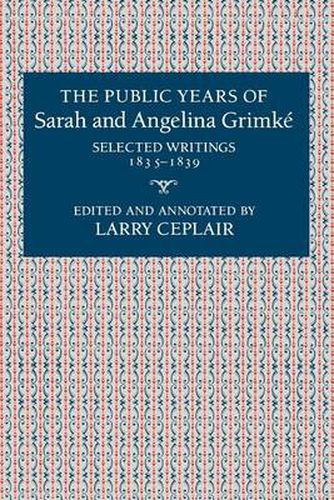
Sarah Moore Grimke and Angelina Emily Grimke were the first women in America coming from a southern slave-holding family to speak publicly on behalf of the abolition of slavery. Creating a stir of controversy soon afterwards during the 1830s especially with the force of their testimony before the Massachusetts State Legislature, they soon found themselves defending publicly and at length the right of women to speak on moral and political issues and on the end of the subordination of women. The editor of this collection of eloquent political writings, Larry Ceplair, has written a critical introduction situating the Grimkes’ in an historical and political context in which he describes the significance of their thought and work. Of special interest is the inclusion of writings documenting the Grimke sisters activities that preceded by 11 years the first woman’s rights convention in America, held at Seneca Falls, N.Y., in 1848. Most of the Grimke sisters writings are out of print today. Mr. Ceplair’s efforts will be greatly appreciated by those interested in the history of feminist theory, antebellum history.
$9.00 standard shipping within Australia
FREE standard shipping within Australia for orders over $100.00
Express & International shipping calculated at checkout
Stock availability can be subject to change without notice. We recommend calling the shop or contacting our online team to check availability of low stock items. Please see our Shopping Online page for more details.
Sarah Moore Grimke and Angelina Emily Grimke were the first women in America coming from a southern slave-holding family to speak publicly on behalf of the abolition of slavery. Creating a stir of controversy soon afterwards during the 1830s especially with the force of their testimony before the Massachusetts State Legislature, they soon found themselves defending publicly and at length the right of women to speak on moral and political issues and on the end of the subordination of women. The editor of this collection of eloquent political writings, Larry Ceplair, has written a critical introduction situating the Grimkes’ in an historical and political context in which he describes the significance of their thought and work. Of special interest is the inclusion of writings documenting the Grimke sisters activities that preceded by 11 years the first woman’s rights convention in America, held at Seneca Falls, N.Y., in 1848. Most of the Grimke sisters writings are out of print today. Mr. Ceplair’s efforts will be greatly appreciated by those interested in the history of feminist theory, antebellum history.
Search our extensive online catalogue.
