Readings Newsletter
Become a Readings Member to make your shopping experience even easier.
Sign in or sign up for free!
You’re not far away from qualifying for FREE standard shipping within Australia
You’ve qualified for FREE standard shipping within Australia
The cart is loading…


This title is printed to order. This book may have been self-published. If so, we cannot guarantee the quality of the content. In the main most books will have gone through the editing process however some may not. We therefore suggest that you be aware of this before ordering this book. If in doubt check either the author or publisher’s details as we are unable to accept any returns unless they are faulty. Please contact us if you have any questions.
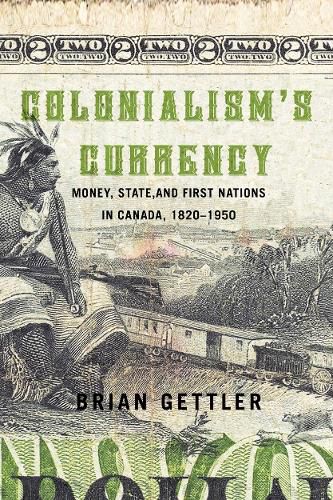
Money, often portrayed as a straightforward representation of market value, is also a political force, a technology for remaking space and population. This was especially true in nineteenth- and twentieth-century Canada, where money - in many forms - provided an effective means of disseminating colonial social values, laying claim to national space, and disciplining colonized peoples. Colonialism’s Currency analyzes the historical experiences and interactions of three distinct First Nations - the Wendat of Wendake, the Innu of Mashteuiatsh, and the Moose Factory Cree - with monetary forms and practices created by colonial powers. Whether treaty payments and welfare provisions such as the paper vouchers favoured by the Department of Indian Affairs, the Canadian Dominion’s standardized paper notes, or the made beaver (the Hudson’s Bay Company’s money of account), each monetary form allowed the state to communicate and enforce political, economic, and cultural sovereignty over Indigenous peoples and their lands. Surveying a range of historical cases, Brian Gettler shows how currency simultaneously placed First Nations beyond the bounds of settler society while justifying colonial interventions in their communities. Testifying to the destructive and the legitimizing power of money, Colonialism’s Currency is an intriguing exploration of the complex relationship between First Nations and the state.
$9.00 standard shipping within Australia
FREE standard shipping within Australia for orders over $100.00
Express & International shipping calculated at checkout
Stock availability can be subject to change without notice. We recommend calling the shop or contacting our online team to check availability of low stock items. Please see our Shopping Online page for more details.
This title is printed to order. This book may have been self-published. If so, we cannot guarantee the quality of the content. In the main most books will have gone through the editing process however some may not. We therefore suggest that you be aware of this before ordering this book. If in doubt check either the author or publisher’s details as we are unable to accept any returns unless they are faulty. Please contact us if you have any questions.
Money, often portrayed as a straightforward representation of market value, is also a political force, a technology for remaking space and population. This was especially true in nineteenth- and twentieth-century Canada, where money - in many forms - provided an effective means of disseminating colonial social values, laying claim to national space, and disciplining colonized peoples. Colonialism’s Currency analyzes the historical experiences and interactions of three distinct First Nations - the Wendat of Wendake, the Innu of Mashteuiatsh, and the Moose Factory Cree - with monetary forms and practices created by colonial powers. Whether treaty payments and welfare provisions such as the paper vouchers favoured by the Department of Indian Affairs, the Canadian Dominion’s standardized paper notes, or the made beaver (the Hudson’s Bay Company’s money of account), each monetary form allowed the state to communicate and enforce political, economic, and cultural sovereignty over Indigenous peoples and their lands. Surveying a range of historical cases, Brian Gettler shows how currency simultaneously placed First Nations beyond the bounds of settler society while justifying colonial interventions in their communities. Testifying to the destructive and the legitimizing power of money, Colonialism’s Currency is an intriguing exploration of the complex relationship between First Nations and the state.
Search our extensive online catalogue.
