Readings Newsletter
Become a Readings Member to make your shopping experience even easier.
Sign in or sign up for free!
You’re not far away from qualifying for FREE standard shipping within Australia
You’ve qualified for FREE standard shipping within Australia
The cart is loading…


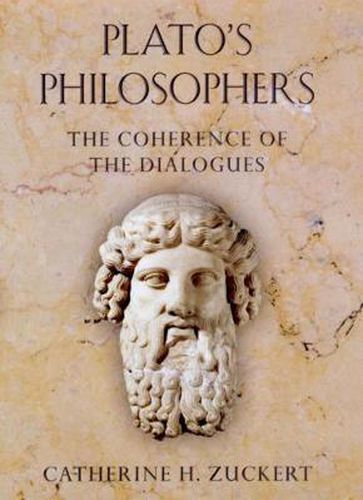
Faced with the difficult task of discerning Plato’s true ideas\nfrom the contradictory voices he used to express them, scholars\nhave never fully made sense of the many incompatibilities within\nand between the dialogues. In the magisterial Plato’s\nPhilosophers, Catherine Zuckert explains for the first time\nhow these prose dramas cohere to reveal a comprehensive Platonic\nunderstanding of philosophy.
\n
To expose this coherence, Zuckert examines the dialogues not in\ntheir supposed order of composition but according to the dramatic\norder in which Plato indicates they took place. This unconventional\narrangement lays bare a narrative of the rise, development, and\nlimitations of Socratic philosophy. In the drama’s earliest\ndialogues, for example, non-Socratic philosophers introduce the\npolitical and philosophical problems to which Socrates tries to\nrespond. A second dramatic group shows how Socrates develops his\ndistinctive philosophical style. And, finally, the later dialogues\nfeature interlocutors who reveal his philosophy’s limitations.\nDespite these limitations, Zuckert concludes, Plato made Socrates\nthe dialogues’ central figure because Socrates raises the\nfundamental human question: what is the best way to live?
\n
Plato’s dramatization of Socratic imperfections suggests,\nmoreover, that he recognized the apparently unbridgeable gap\nbetween our understandings of human life and the nonhuman world. At\na time when this gap continues to raise questions—about the\ndivision between sciences and the humanities and the potentially\ndehumanizing effects of scientific progress—Zuckert’s brilliant\ninterpretation of the entire Platonic corpus offers genuinely new\ninsights into worlds past and present.
\n\n
$9.00 standard shipping within Australia
FREE standard shipping within Australia for orders over $100.00
Express & International shipping calculated at checkout
Stock availability can be subject to change without notice. We recommend calling the shop or contacting our online team to check availability of low stock items. Please see our Shopping Online page for more details.
Faced with the difficult task of discerning Plato’s true ideas\nfrom the contradictory voices he used to express them, scholars\nhave never fully made sense of the many incompatibilities within\nand between the dialogues. In the magisterial Plato’s\nPhilosophers, Catherine Zuckert explains for the first time\nhow these prose dramas cohere to reveal a comprehensive Platonic\nunderstanding of philosophy.
\n
To expose this coherence, Zuckert examines the dialogues not in\ntheir supposed order of composition but according to the dramatic\norder in which Plato indicates they took place. This unconventional\narrangement lays bare a narrative of the rise, development, and\nlimitations of Socratic philosophy. In the drama’s earliest\ndialogues, for example, non-Socratic philosophers introduce the\npolitical and philosophical problems to which Socrates tries to\nrespond. A second dramatic group shows how Socrates develops his\ndistinctive philosophical style. And, finally, the later dialogues\nfeature interlocutors who reveal his philosophy’s limitations.\nDespite these limitations, Zuckert concludes, Plato made Socrates\nthe dialogues’ central figure because Socrates raises the\nfundamental human question: what is the best way to live?
\n
Plato’s dramatization of Socratic imperfections suggests,\nmoreover, that he recognized the apparently unbridgeable gap\nbetween our understandings of human life and the nonhuman world. At\na time when this gap continues to raise questions—about the\ndivision between sciences and the humanities and the potentially\ndehumanizing effects of scientific progress—Zuckert’s brilliant\ninterpretation of the entire Platonic corpus offers genuinely new\ninsights into worlds past and present.
\n\n
Search our extensive online catalogue.
