Readings Newsletter
Become a Readings Member to make your shopping experience even easier.
Sign in or sign up for free!
You’re not far away from qualifying for FREE standard shipping within Australia
You’ve qualified for FREE standard shipping within Australia
The cart is loading…


Why do majority congressional parties seem unable to act as an effective policy-making force? They routinely delegate their power to others–internally to standing committees and subcommittees within each chamber, externally to the president and to the bureaucracy. Conventional wisdom in political science insists that such delegation leads inevitably to abdication–usually by degrees, sometimes precipitously, but always completely.
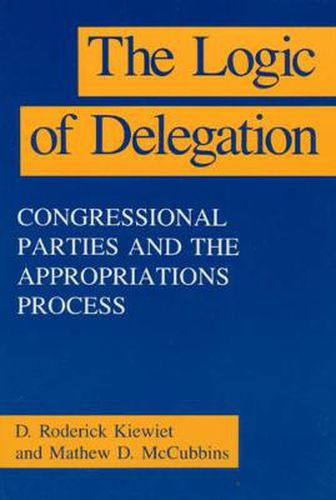
In The Logic of Delegation, however, D. Roderick Kiewiet and Mathew D. McCubbins persuasively argue that political scientists have paid far too much attention to what congressional parties can’t do. The authors draw on economic and management theory to demonstrate that the effectiveness of delegation is determined not by how much authority is delegated but rather by how well it is delegated.
In the context of the appropriations process, the authors show how congressional parties employ committees, subcommittees, and executive agencies to accomplish policy goals. This innovative study will force a complete rethinking of classic issues in American politics: the autonomy of congressional committees; the reality of runaway federal bureaucracy; and the supposed dominance of the presidency in legislative-executive relations.
$9.00 standard shipping within Australia
FREE standard shipping within Australia for orders over $100.00
Express & International shipping calculated at checkout
Stock availability can be subject to change without notice. We recommend calling the shop or contacting our online team to check availability of low stock items. Please see our Shopping Online page for more details.
Why do majority congressional parties seem unable to act as an effective policy-making force? They routinely delegate their power to others–internally to standing committees and subcommittees within each chamber, externally to the president and to the bureaucracy. Conventional wisdom in political science insists that such delegation leads inevitably to abdication–usually by degrees, sometimes precipitously, but always completely.
In The Logic of Delegation, however, D. Roderick Kiewiet and Mathew D. McCubbins persuasively argue that political scientists have paid far too much attention to what congressional parties can’t do. The authors draw on economic and management theory to demonstrate that the effectiveness of delegation is determined not by how much authority is delegated but rather by how well it is delegated.
In the context of the appropriations process, the authors show how congressional parties employ committees, subcommittees, and executive agencies to accomplish policy goals. This innovative study will force a complete rethinking of classic issues in American politics: the autonomy of congressional committees; the reality of runaway federal bureaucracy; and the supposed dominance of the presidency in legislative-executive relations.
Search our extensive online catalogue.
