Readings Newsletter
Become a Readings Member to make your shopping experience even easier.
Sign in or sign up for free!
You’re not far away from qualifying for FREE standard shipping within Australia
You’ve qualified for FREE standard shipping within Australia
The cart is loading…


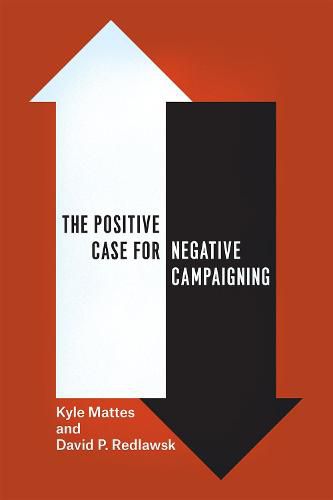
Turn on the television or sign in to social media during election season and chances are you’ll see plenty of negative campaigning. For decades, conventional wisdom has held that Americans hate negativity in political advertising, and some have even argued that its pervasiveness in recent seasons has helped to drive down voter turnout. Arguing against this commonly held view, Kyle Mattes and David P. Redlawsk show not only that some negativity is accepted by voters as part of the political process, but that negative advertising is necessary to convey valuable information that would not otherwise be revealed.
The most comprehensive treatment of negative campaigning to date, The Positive Case for Negative Campaigning uses models, surveys, and experiments to show that much of the seeming dislike of negative campaigning can be explained by the way survey questions have been worded. By failing to distinguish between baseless and credible attacks, surveys fail to capture differences in voters’ receptivity. Voters’ responses, the authors argue, vary greatly and can be better explained by the content and believability of the ads than by whether the ads are negative. Mattes and Redlawsk continue on to establish how voters make use of negative information and why it is necessary. Many voters are politically naive and unlikely to make inferences about candidates’ positions or traits, so the ability of candidates to go on the attack and focus explicitly on information that would not otherwise be available is crucial to voter education.
$9.00 standard shipping within Australia
FREE standard shipping within Australia for orders over $100.00
Express & International shipping calculated at checkout
Stock availability can be subject to change without notice. We recommend calling the shop or contacting our online team to check availability of low stock items. Please see our Shopping Online page for more details.
Turn on the television or sign in to social media during election season and chances are you’ll see plenty of negative campaigning. For decades, conventional wisdom has held that Americans hate negativity in political advertising, and some have even argued that its pervasiveness in recent seasons has helped to drive down voter turnout. Arguing against this commonly held view, Kyle Mattes and David P. Redlawsk show not only that some negativity is accepted by voters as part of the political process, but that negative advertising is necessary to convey valuable information that would not otherwise be revealed.
The most comprehensive treatment of negative campaigning to date, The Positive Case for Negative Campaigning uses models, surveys, and experiments to show that much of the seeming dislike of negative campaigning can be explained by the way survey questions have been worded. By failing to distinguish between baseless and credible attacks, surveys fail to capture differences in voters’ receptivity. Voters’ responses, the authors argue, vary greatly and can be better explained by the content and believability of the ads than by whether the ads are negative. Mattes and Redlawsk continue on to establish how voters make use of negative information and why it is necessary. Many voters are politically naive and unlikely to make inferences about candidates’ positions or traits, so the ability of candidates to go on the attack and focus explicitly on information that would not otherwise be available is crucial to voter education.
Search our extensive online catalogue.
