Readings Newsletter
Become a Readings Member to make your shopping experience even easier.
Sign in or sign up for free!
You’re not far away from qualifying for FREE standard shipping within Australia
You’ve qualified for FREE standard shipping within Australia
The cart is loading…


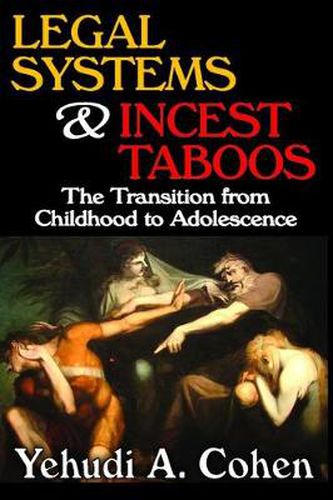
The goal of this book is to investigate why there are two distinct notions of liability in the legal and ethical systems of different societies; the relationship between two sets of criteria of liability on one hand and the individual’s evolution from childhood adolescence. The specific ways in which different societies cope with transition from childhood to adolescence are important because a sense of responsibility, consonant with the goals of the society and survival of family and culture is implanted in the growing child. The ways in which incest taboos are taught constitute one of the crucial modes by which a sense of responsibility is implanted within an individual during his transition from childhood to adolescence. The author places most of his focus on social systems, the transition from childhood to adolescence. Theoretical concerns are with the ways in which human biology and human social structures meet with impact each other. The fact that wide variations do exist among societies in connection with certain types of incest taboos does not lead inevitably to the conclusion that there is no biological basis for the incest taboo. The immediate impression of variability can be misleading; extreme differences between cultures in the same institutional realm, as between individuals, often reveal remarkable regularity and consistency. These regularities are seen in the cultural phenomena; the assumption that biology and culture are bound up in their manifestations is fundamental in understanding their nature.
$9.00 standard shipping within Australia
FREE standard shipping within Australia for orders over $100.00
Express & International shipping calculated at checkout
Stock availability can be subject to change without notice. We recommend calling the shop or contacting our online team to check availability of low stock items. Please see our Shopping Online page for more details.
The goal of this book is to investigate why there are two distinct notions of liability in the legal and ethical systems of different societies; the relationship between two sets of criteria of liability on one hand and the individual’s evolution from childhood adolescence. The specific ways in which different societies cope with transition from childhood to adolescence are important because a sense of responsibility, consonant with the goals of the society and survival of family and culture is implanted in the growing child. The ways in which incest taboos are taught constitute one of the crucial modes by which a sense of responsibility is implanted within an individual during his transition from childhood to adolescence. The author places most of his focus on social systems, the transition from childhood to adolescence. Theoretical concerns are with the ways in which human biology and human social structures meet with impact each other. The fact that wide variations do exist among societies in connection with certain types of incest taboos does not lead inevitably to the conclusion that there is no biological basis for the incest taboo. The immediate impression of variability can be misleading; extreme differences between cultures in the same institutional realm, as between individuals, often reveal remarkable regularity and consistency. These regularities are seen in the cultural phenomena; the assumption that biology and culture are bound up in their manifestations is fundamental in understanding their nature.
Search our extensive online catalogue.
