Readings Newsletter
Become a Readings Member to make your shopping experience even easier.
Sign in or sign up for free!
You’re not far away from qualifying for FREE standard shipping within Australia
You’ve qualified for FREE standard shipping within Australia
The cart is loading…


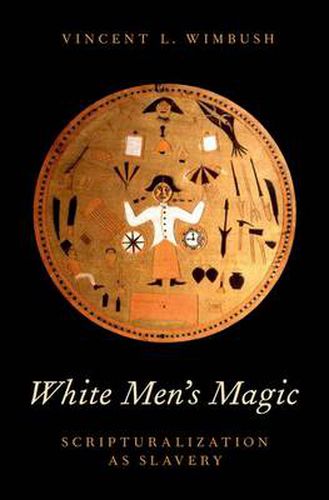
The Interesting Narrative of the Life of Olaudah Equiano, or Gustavus Vassa, the African, first published in England in 1789, was one of the earliest and remains to this day one of the best-known English language slave narratives. Characterizing Olaudah Equiano’s eighteenth-century narrative of his life as a type of “scriptural story” that connects the Bible with identity formation, Vincent L. Wimbush’s White Men’s Magic probes not only how the Bible and its reading played a crucial role in the first colonial contacts between black and white persons in the North Atlantic but also the process and meaning of what he terms “scripturalization.” By this term, Wimbush means “a social-psychological-political discursive structure” or “semiosphere” that creates a reality and organizes a society in terms of relations and communications. This scripturalization, achieved by the British to establish a colonial and racialized society in and through the promotion of literacy and the Bible as a “fetishized center-object,” was also performed by an abject outsider or stranger like Equiano through his reading of the Bible as well as his own writing with the goal of imagining and promoting a more inclusive society. It is for this reason that Wimbush calls Equiano’s narrative a “scriptural story,” and he argues that this is why the talking book trope appears repeatedly in writings of eighteenth- and early nineteenth-century black Atlantic writers. He identifies three different types of scripturalization: (1) scripturalization as social-cultural matrix and comparative magic; (2) scripturalization in the service of nationalization and for the purpose of naturalization; and (3) scripturalization in negotiation and for resistance. Because it is based on the particularities of Equiano’s narrative, Wimbush’s theoretical work is not only grounded but inductive. Wimbush shows that scripturalization is bigger than either the historical or the literary Equiano. Scripturalization was not invented by Equiano, he says, but it is not quite the same after Equiano.
$9.00 standard shipping within Australia
FREE standard shipping within Australia for orders over $100.00
Express & International shipping calculated at checkout
Stock availability can be subject to change without notice. We recommend calling the shop or contacting our online team to check availability of low stock items. Please see our Shopping Online page for more details.
The Interesting Narrative of the Life of Olaudah Equiano, or Gustavus Vassa, the African, first published in England in 1789, was one of the earliest and remains to this day one of the best-known English language slave narratives. Characterizing Olaudah Equiano’s eighteenth-century narrative of his life as a type of “scriptural story” that connects the Bible with identity formation, Vincent L. Wimbush’s White Men’s Magic probes not only how the Bible and its reading played a crucial role in the first colonial contacts between black and white persons in the North Atlantic but also the process and meaning of what he terms “scripturalization.” By this term, Wimbush means “a social-psychological-political discursive structure” or “semiosphere” that creates a reality and organizes a society in terms of relations and communications. This scripturalization, achieved by the British to establish a colonial and racialized society in and through the promotion of literacy and the Bible as a “fetishized center-object,” was also performed by an abject outsider or stranger like Equiano through his reading of the Bible as well as his own writing with the goal of imagining and promoting a more inclusive society. It is for this reason that Wimbush calls Equiano’s narrative a “scriptural story,” and he argues that this is why the talking book trope appears repeatedly in writings of eighteenth- and early nineteenth-century black Atlantic writers. He identifies three different types of scripturalization: (1) scripturalization as social-cultural matrix and comparative magic; (2) scripturalization in the service of nationalization and for the purpose of naturalization; and (3) scripturalization in negotiation and for resistance. Because it is based on the particularities of Equiano’s narrative, Wimbush’s theoretical work is not only grounded but inductive. Wimbush shows that scripturalization is bigger than either the historical or the literary Equiano. Scripturalization was not invented by Equiano, he says, but it is not quite the same after Equiano.
Search our extensive online catalogue.
