Readings Newsletter
Become a Readings Member to make your shopping experience even easier.
Sign in or sign up for free!
You’re not far away from qualifying for FREE standard shipping within Australia
You’ve qualified for FREE standard shipping within Australia
The cart is loading…


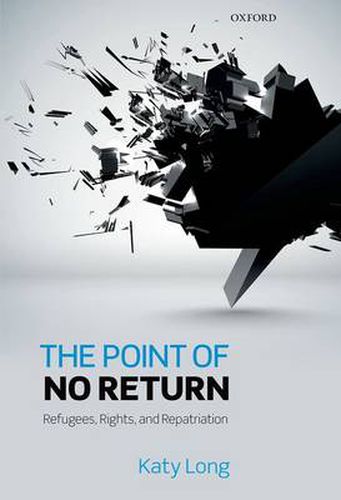
In the past twenty years, over 25 million refugees have returned ‘home’. These refugee repatriations are considered by the international community to be the only real means of solving mass refugee crises. Yet despite the importance placed on repatriation–both in principle and practice–there has been very little exploration of the political controversies that have framed refugee return. Several questions remain unresolved: do refugees have a right to refuse return? How can you remake citizenship after exile? Is ‘home’ a place or a community? How should the liberal principles be balanced against nationalist state order?
The Point of No Return: Rights, Refugees and Repatriation sets out to answer these questions and to examine the fundamental tensions between liberalism and nationalism that repatriation exposes. It makes clear that repatriation cannot be considered as a mere act of border-crossing, a physical moment of ‘return’. Instead, repatriation must be recognised to be a complex political process, involving the remaking of a relationship between citizen and state, the recreation of a social contract. Importantly, The Point of No Return shows that this rebuilding of political community need not actually involve refugees becoming residents in their country of origin. Instead, refugees may rebuild their state-citizen relationship while living as migrants, or holding regional or dual citizenships. In fact, in some settings, ‘mobile’ repatriation may not just be a possible but a necessary form of post-conflict citizenship. The Point of No Return therefore concludes with the radical claim that repatriation not only can but also sometimes should happen without return.
$9.00 standard shipping within Australia
FREE standard shipping within Australia for orders over $100.00
Express & International shipping calculated at checkout
Stock availability can be subject to change without notice. We recommend calling the shop or contacting our online team to check availability of low stock items. Please see our Shopping Online page for more details.
In the past twenty years, over 25 million refugees have returned ‘home’. These refugee repatriations are considered by the international community to be the only real means of solving mass refugee crises. Yet despite the importance placed on repatriation–both in principle and practice–there has been very little exploration of the political controversies that have framed refugee return. Several questions remain unresolved: do refugees have a right to refuse return? How can you remake citizenship after exile? Is ‘home’ a place or a community? How should the liberal principles be balanced against nationalist state order?
The Point of No Return: Rights, Refugees and Repatriation sets out to answer these questions and to examine the fundamental tensions between liberalism and nationalism that repatriation exposes. It makes clear that repatriation cannot be considered as a mere act of border-crossing, a physical moment of ‘return’. Instead, repatriation must be recognised to be a complex political process, involving the remaking of a relationship between citizen and state, the recreation of a social contract. Importantly, The Point of No Return shows that this rebuilding of political community need not actually involve refugees becoming residents in their country of origin. Instead, refugees may rebuild their state-citizen relationship while living as migrants, or holding regional or dual citizenships. In fact, in some settings, ‘mobile’ repatriation may not just be a possible but a necessary form of post-conflict citizenship. The Point of No Return therefore concludes with the radical claim that repatriation not only can but also sometimes should happen without return.
Search our extensive online catalogue.
