Readings Newsletter
Become a Readings Member to make your shopping experience even easier.
Sign in or sign up for free!
You’re not far away from qualifying for FREE standard shipping within Australia
You’ve qualified for FREE standard shipping within Australia
The cart is loading…


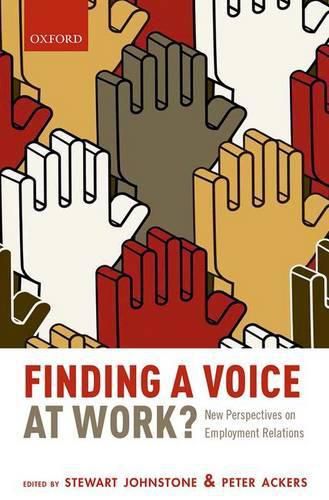
How much ‘say’ should employees have in the running of business organizations, and what form should the ‘voice’ take? This is both the oldest and latest question in employment relations. Answers to these questions reflect our fundamental assumptions about the nature of the employment relationship, and inform our views on almost every aspect of Human Resource Management (HRM) and Employment Relations.Voice can also mean different things to different people. For some, employee voice is a synonym for trade union representation which aims to defend and promote the collective interests of workers. For others voice, is means of enhancing employee commitment and organisational performance. Others advocate workers control as an alternative to conventional capitalist organisations which are run for shareholders. There is thus both a moral and political argument for a measure of democracy at work, as well as a business case argument, which views voice as a potential link in the quest for increased organisational performance.
The key debate for employment relations is which of the approaches ‘works best’ in delivering outcomes which balance competitiveness and productivity, on the one hand, and fair treatment of workers and social justice on the other. Policy makers need pragmatic answers to enduring questions: what works best in different contexts, what are the conditions of success, and what are the drawbacks? Some of the most significant developments in employee voice have taken place within the European Union, with various public policy and employer experiments attracting extensive academic research. The book offers a critical assessment of the main contemporary concepts and models of voice in the UK and Europe, and provides an in-depth theoretical and empirical exploration of employee voice in one accessible and cohesive collection.
$9.00 standard shipping within Australia
FREE standard shipping within Australia for orders over $100.00
Express & International shipping calculated at checkout
Stock availability can be subject to change without notice. We recommend calling the shop or contacting our online team to check availability of low stock items. Please see our Shopping Online page for more details.
How much ‘say’ should employees have in the running of business organizations, and what form should the ‘voice’ take? This is both the oldest and latest question in employment relations. Answers to these questions reflect our fundamental assumptions about the nature of the employment relationship, and inform our views on almost every aspect of Human Resource Management (HRM) and Employment Relations.Voice can also mean different things to different people. For some, employee voice is a synonym for trade union representation which aims to defend and promote the collective interests of workers. For others voice, is means of enhancing employee commitment and organisational performance. Others advocate workers control as an alternative to conventional capitalist organisations which are run for shareholders. There is thus both a moral and political argument for a measure of democracy at work, as well as a business case argument, which views voice as a potential link in the quest for increased organisational performance.
The key debate for employment relations is which of the approaches ‘works best’ in delivering outcomes which balance competitiveness and productivity, on the one hand, and fair treatment of workers and social justice on the other. Policy makers need pragmatic answers to enduring questions: what works best in different contexts, what are the conditions of success, and what are the drawbacks? Some of the most significant developments in employee voice have taken place within the European Union, with various public policy and employer experiments attracting extensive academic research. The book offers a critical assessment of the main contemporary concepts and models of voice in the UK and Europe, and provides an in-depth theoretical and empirical exploration of employee voice in one accessible and cohesive collection.
Search our extensive online catalogue.
