Readings Newsletter
Become a Readings Member to make your shopping experience even easier.
Sign in or sign up for free!
You’re not far away from qualifying for FREE standard shipping within Australia
You’ve qualified for FREE standard shipping within Australia
The cart is loading…


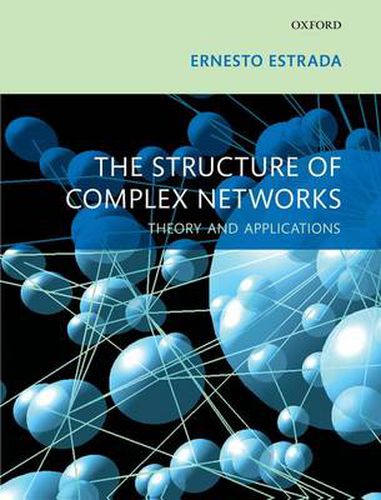
This book deals with the analysis of the structure of complex networks by combining results from graph theory, physics, and pattern recognition. The book is divided into two parts. 11 chapters are dedicated to the development of theoretical tools for the structural analysis of networks, and 7 chapters are illustrating, in a critical way, applications of these tools to real-world scenarios. The first chapters provide detailed coverage of adjacency and metric and topological properties of networks, followed by chapters devoted to the analysis of individual fragments and fragment-based global invariants in complex networks. Chapters that analyse the concepts of communicability, centrality, bipartivity, expansibility and communities in networks follow. The second part of this book is devoted to the analysis of genetic, protein residue, protein-protein interaction, intercellular, ecological and socio-economic networks, including important breakthroughs as well as examples of the misuse of structural concepts.
$9.00 standard shipping within Australia
FREE standard shipping within Australia for orders over $100.00
Express & International shipping calculated at checkout
Stock availability can be subject to change without notice. We recommend calling the shop or contacting our online team to check availability of low stock items. Please see our Shopping Online page for more details.
This book deals with the analysis of the structure of complex networks by combining results from graph theory, physics, and pattern recognition. The book is divided into two parts. 11 chapters are dedicated to the development of theoretical tools for the structural analysis of networks, and 7 chapters are illustrating, in a critical way, applications of these tools to real-world scenarios. The first chapters provide detailed coverage of adjacency and metric and topological properties of networks, followed by chapters devoted to the analysis of individual fragments and fragment-based global invariants in complex networks. Chapters that analyse the concepts of communicability, centrality, bipartivity, expansibility and communities in networks follow. The second part of this book is devoted to the analysis of genetic, protein residue, protein-protein interaction, intercellular, ecological and socio-economic networks, including important breakthroughs as well as examples of the misuse of structural concepts.
Search our extensive online catalogue.
