Readings Newsletter
Become a Readings Member to make your shopping experience even easier.
Sign in or sign up for free!
You’re not far away from qualifying for FREE standard shipping within Australia
You’ve qualified for FREE standard shipping within Australia
The cart is loading…


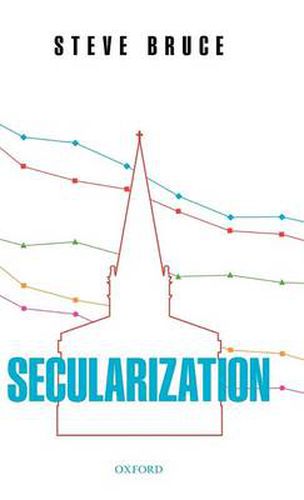
The decline in power, popularity and prestige of religion across the modern world is not a short-term or localized trend nor is it an accident. It is a consequence of subtle but powerful features of modernization. Renowned sociologist, Steve Bruce, elaborates the secularization paradigm and defends it against a wide variety of recent attempts at rebuttal and refutation. Using the best available statistical and qualitative evidence Bruce considers the implications for the secularization paradigm of the extent to which new religious movements or New Age spiritualities are replacing religion; changes in the nature and power of folk religion and superstition; rational choice alternatives to the secularization paradigm; the popularity and political influence of religion in the USA; religious change in the developing world; reactions to Islam in Europe; and the effects of recent controversies over the public place of religion. Bruce presents a robust defence of the secularization paradigm, clarifying its arguments for the benefit of all sides of the debate.
$9.00 standard shipping within Australia
FREE standard shipping within Australia for orders over $100.00
Express & International shipping calculated at checkout
Stock availability can be subject to change without notice. We recommend calling the shop or contacting our online team to check availability of low stock items. Please see our Shopping Online page for more details.
The decline in power, popularity and prestige of religion across the modern world is not a short-term or localized trend nor is it an accident. It is a consequence of subtle but powerful features of modernization. Renowned sociologist, Steve Bruce, elaborates the secularization paradigm and defends it against a wide variety of recent attempts at rebuttal and refutation. Using the best available statistical and qualitative evidence Bruce considers the implications for the secularization paradigm of the extent to which new religious movements or New Age spiritualities are replacing religion; changes in the nature and power of folk religion and superstition; rational choice alternatives to the secularization paradigm; the popularity and political influence of religion in the USA; religious change in the developing world; reactions to Islam in Europe; and the effects of recent controversies over the public place of religion. Bruce presents a robust defence of the secularization paradigm, clarifying its arguments for the benefit of all sides of the debate.
Search our extensive online catalogue.
