Readings Newsletter
Become a Readings Member to make your shopping experience even easier.
Sign in or sign up for free!
You’re not far away from qualifying for FREE standard shipping within Australia
You’ve qualified for FREE standard shipping within Australia
The cart is loading…


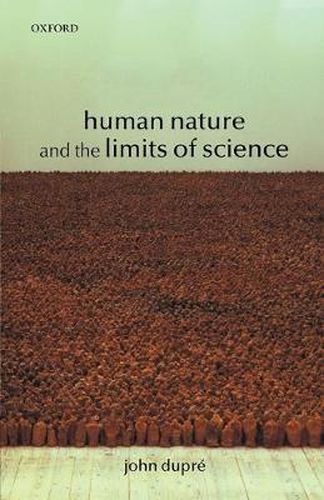
John Dupre warns that our understanding of human nature is being distorted by two faulty and harmful forms of pseudo-scientific thinking. Not just in the academic world but increasingly in everyday life, we find one set of experts seeking to explain the ends at which humans aim in terms of evolutionary theory, and another set of experts using economic models to give rules of how we act to achieve those ends. Dupre charges this unholy alliance of evolutionary psychologists and rational-choice theorists with scientific imperialism: they use methods and ideas developed for one domain of inquiry in others where they are inappropriate. He demonstrates that these theorists’ explanations do not work, and furthermore that if taken seriously their theories tend to have dangerous social and political consequences. For these reasons, it is important to resist scientism - an exaggerated conception of what science can be expected to do for us. To say this is in no way to be against science - just against bad science. Dupre restores sanity to the study of human nature by pointing the way to a proper understanding of humans in the societies that are our natural and necessary environments. He shows how our distinctively human capacities are shaped by the social contexts in which we are embedded. And he concludes with a bold challenge to one of the intellectual touchstones of modern science: the idea of the universe as causally complete and deterministic. In an impressive rehabilitation of the idea of free human agency, he argues that far from being helpless cogs in a mechanistic universe, humans are rare concentrations of causal power in a largely indeterministic world. Human Nature and the Limits of Science is a provocative, witty, and persuasive corrective to scientism. In its place, Dupre commends a pluralistic approach to science, as the appropriate way to investigate a universe that is not unified in form. Anyone interested in science and human nature will enjoy this book, unless they are its targets.
$9.00 standard shipping within Australia
FREE standard shipping within Australia for orders over $100.00
Express & International shipping calculated at checkout
Stock availability can be subject to change without notice. We recommend calling the shop or contacting our online team to check availability of low stock items. Please see our Shopping Online page for more details.
John Dupre warns that our understanding of human nature is being distorted by two faulty and harmful forms of pseudo-scientific thinking. Not just in the academic world but increasingly in everyday life, we find one set of experts seeking to explain the ends at which humans aim in terms of evolutionary theory, and another set of experts using economic models to give rules of how we act to achieve those ends. Dupre charges this unholy alliance of evolutionary psychologists and rational-choice theorists with scientific imperialism: they use methods and ideas developed for one domain of inquiry in others where they are inappropriate. He demonstrates that these theorists’ explanations do not work, and furthermore that if taken seriously their theories tend to have dangerous social and political consequences. For these reasons, it is important to resist scientism - an exaggerated conception of what science can be expected to do for us. To say this is in no way to be against science - just against bad science. Dupre restores sanity to the study of human nature by pointing the way to a proper understanding of humans in the societies that are our natural and necessary environments. He shows how our distinctively human capacities are shaped by the social contexts in which we are embedded. And he concludes with a bold challenge to one of the intellectual touchstones of modern science: the idea of the universe as causally complete and deterministic. In an impressive rehabilitation of the idea of free human agency, he argues that far from being helpless cogs in a mechanistic universe, humans are rare concentrations of causal power in a largely indeterministic world. Human Nature and the Limits of Science is a provocative, witty, and persuasive corrective to scientism. In its place, Dupre commends a pluralistic approach to science, as the appropriate way to investigate a universe that is not unified in form. Anyone interested in science and human nature will enjoy this book, unless they are its targets.
Search our extensive online catalogue.
