Readings Newsletter
Become a Readings Member to make your shopping experience even easier.
Sign in or sign up for free!
You’re not far away from qualifying for FREE standard shipping within Australia
You’ve qualified for FREE standard shipping within Australia
The cart is loading…


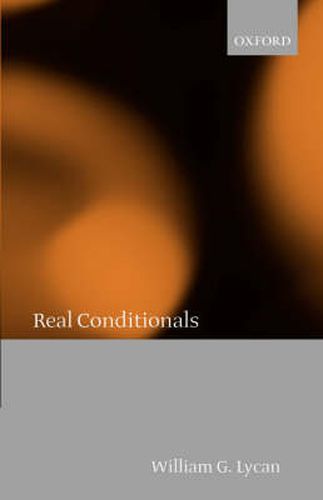
Philosophers and logicians have long debated how best to understand conditional or hypothetical sentences. William G. Lycan has a distinctive approach to this debate, attending not just to the semantics of such sentences, but equally to their syntax. He shows how insights from linguistic theory help to illuminate problems about the meaning and function of conditionals. For instance, philosophers and logicians have had problems analysing the locutions ‘only if’, ‘unless’, and ‘even if’. Lycan sets out a general semantic theory of conditionals which works for all such sentences; he assigns meanings to them in a way that explains how and why those meanings depend upon features of utterance context. According to Lycan’s theory the ‘if’-clauses refer to items called ‘events’, ‘circumstances’, or ‘conditions’. Real Conditionals gives at last the definitive presentation of this original approach to a topic at the intersection of philosophy, logic, and linguistics. Lycan’s characteristically lively and witty expository style ensures that it can be enjoyed by readers from all three disciplines.
$9.00 standard shipping within Australia
FREE standard shipping within Australia for orders over $100.00
Express & International shipping calculated at checkout
Stock availability can be subject to change without notice. We recommend calling the shop or contacting our online team to check availability of low stock items. Please see our Shopping Online page for more details.
Philosophers and logicians have long debated how best to understand conditional or hypothetical sentences. William G. Lycan has a distinctive approach to this debate, attending not just to the semantics of such sentences, but equally to their syntax. He shows how insights from linguistic theory help to illuminate problems about the meaning and function of conditionals. For instance, philosophers and logicians have had problems analysing the locutions ‘only if’, ‘unless’, and ‘even if’. Lycan sets out a general semantic theory of conditionals which works for all such sentences; he assigns meanings to them in a way that explains how and why those meanings depend upon features of utterance context. According to Lycan’s theory the ‘if’-clauses refer to items called ‘events’, ‘circumstances’, or ‘conditions’. Real Conditionals gives at last the definitive presentation of this original approach to a topic at the intersection of philosophy, logic, and linguistics. Lycan’s characteristically lively and witty expository style ensures that it can be enjoyed by readers from all three disciplines.
Search our extensive online catalogue.
