Readings Newsletter
Become a Readings Member to make your shopping experience even easier.
Sign in or sign up for free!
You’re not far away from qualifying for FREE standard shipping within Australia
You’ve qualified for FREE standard shipping within Australia
The cart is loading…


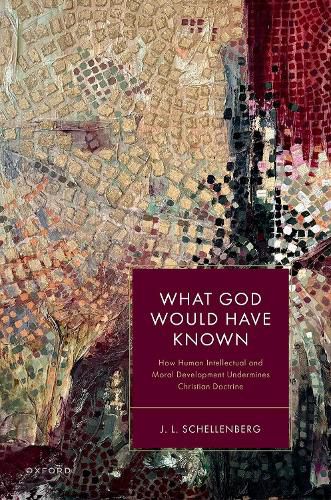
Classical Christian ideas loom large in philosophy of religion today. But arguments against Christian doctrine have been neglected. J. L. Schellenberg's new book remedies this neglect. And it does so in a novel way, by linking facts about human intellectual and moral development to what God would have known at the time of Jesus.The tide of human development, which the early Christians might have expected to corroborate their teaching, has in fact brought many results that run contrary to that teaching. Or at least it will be seen to have done so, says Schellenberg, when we think about the consequences of any God existent then being fully cognizant, when Christian doctrine was first formed, of all that we have laboriously learned since then. Newly discovered facts, not just about such things as evolution and the formation of the New Testament but also about mental illness, violent punishment, the relations between women and men, and the status of same-sex intimacy, suggest detailed new arguments against the content of the Christian revelation--Schellenberg designs and defends twenty--when the prior understanding of the purported revealer is taken into account. Written with Schellenberg's characteristic combination of verve and careful precision, What God Would Have Known offers a thorough and incisive treatment of its subject that remains respectful and fair-minded throughout. It is not concerned with the overworked question of whether classical Christians believe irrationally, but with what overlooked arguments about human development show in relation to the truth or falsity of Christian claims about reality. Fully conversant with relevant developments in science, the book is particularly generous in its attention to recent developments in social and ethical spheres as it works toward its striking conclusion that the God of the Christians, all good and all wise, would not have believed Christian doctrine.
$9.00 standard shipping within Australia
FREE standard shipping within Australia for orders over $100.00
Express & International shipping calculated at checkout
Stock availability can be subject to change without notice. We recommend calling the shop or contacting our online team to check availability of low stock items. Please see our Shopping Online page for more details.
Classical Christian ideas loom large in philosophy of religion today. But arguments against Christian doctrine have been neglected. J. L. Schellenberg's new book remedies this neglect. And it does so in a novel way, by linking facts about human intellectual and moral development to what God would have known at the time of Jesus.The tide of human development, which the early Christians might have expected to corroborate their teaching, has in fact brought many results that run contrary to that teaching. Or at least it will be seen to have done so, says Schellenberg, when we think about the consequences of any God existent then being fully cognizant, when Christian doctrine was first formed, of all that we have laboriously learned since then. Newly discovered facts, not just about such things as evolution and the formation of the New Testament but also about mental illness, violent punishment, the relations between women and men, and the status of same-sex intimacy, suggest detailed new arguments against the content of the Christian revelation--Schellenberg designs and defends twenty--when the prior understanding of the purported revealer is taken into account. Written with Schellenberg's characteristic combination of verve and careful precision, What God Would Have Known offers a thorough and incisive treatment of its subject that remains respectful and fair-minded throughout. It is not concerned with the overworked question of whether classical Christians believe irrationally, but with what overlooked arguments about human development show in relation to the truth or falsity of Christian claims about reality. Fully conversant with relevant developments in science, the book is particularly generous in its attention to recent developments in social and ethical spheres as it works toward its striking conclusion that the God of the Christians, all good and all wise, would not have believed Christian doctrine.
Search our extensive online catalogue.
