Readings Newsletter
Become a Readings Member to make your shopping experience even easier.
Sign in or sign up for free!
You’re not far away from qualifying for FREE standard shipping within Australia
You’ve qualified for FREE standard shipping within Australia
The cart is loading…


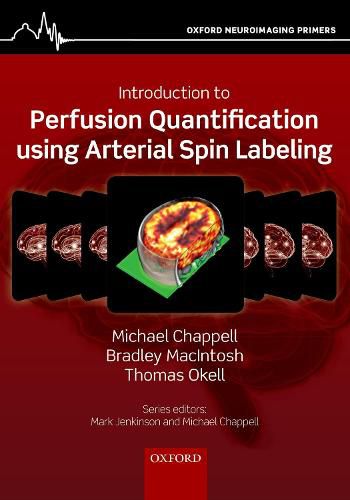
Arterial Spin Labeling (ASL) MRI is an increasingly popular tool to study the brain. What sets it apart from other neuroimaging methods is the combination of quantitative measurements of a physiologically well-defined process, namely perfusion, and a completely non-invasive acquisition methodology.
Cerebral perfusion is a critical component to brain health, as it is the primary means to deliver nutrients to support brain function as well as clearing waste products. Hence it is a useful quantity to study in disease where changes in perfusion can indicate regions of the brain that are pathological. Likewise changes in perfusion can be indicative of greater demand for nutrients, such as might be required in response to an increase in neuronal activity.
With the advent of a consensus by the ASL community on good practice and a recommendation on robust methods for ASL data collection, more and more researchers are now able to access and use ASL. Despite the technological advances, ASL is a technique that exploits subtle changes in brain images associated with blood delivery. This makes the wise choice of the appropriate analysis methods all the more important.
The aim of this primer is to equip someone new to the field of perfusion imaging and ASL with the knowledge not only to make good choices about ASL acquisition and analysis, but also to understand what choices they are making and why. Examples of analysis applied to real data are given throughout the text and instructions on how to reproduce the analyses are illustrated on the primer website.
Written to provide a stand-alone introduction to perfusion qualification using ASL, this primer also works with other texts in the Oxford Neuroimaging Primers series to provide a comprehensive overview of the increasingly influential field of neuroimaging.
$9.00 standard shipping within Australia
FREE standard shipping within Australia for orders over $100.00
Express & International shipping calculated at checkout
Stock availability can be subject to change without notice. We recommend calling the shop or contacting our online team to check availability of low stock items. Please see our Shopping Online page for more details.
Arterial Spin Labeling (ASL) MRI is an increasingly popular tool to study the brain. What sets it apart from other neuroimaging methods is the combination of quantitative measurements of a physiologically well-defined process, namely perfusion, and a completely non-invasive acquisition methodology.
Cerebral perfusion is a critical component to brain health, as it is the primary means to deliver nutrients to support brain function as well as clearing waste products. Hence it is a useful quantity to study in disease where changes in perfusion can indicate regions of the brain that are pathological. Likewise changes in perfusion can be indicative of greater demand for nutrients, such as might be required in response to an increase in neuronal activity.
With the advent of a consensus by the ASL community on good practice and a recommendation on robust methods for ASL data collection, more and more researchers are now able to access and use ASL. Despite the technological advances, ASL is a technique that exploits subtle changes in brain images associated with blood delivery. This makes the wise choice of the appropriate analysis methods all the more important.
The aim of this primer is to equip someone new to the field of perfusion imaging and ASL with the knowledge not only to make good choices about ASL acquisition and analysis, but also to understand what choices they are making and why. Examples of analysis applied to real data are given throughout the text and instructions on how to reproduce the analyses are illustrated on the primer website.
Written to provide a stand-alone introduction to perfusion qualification using ASL, this primer also works with other texts in the Oxford Neuroimaging Primers series to provide a comprehensive overview of the increasingly influential field of neuroimaging.
Search our extensive online catalogue.
