Readings Newsletter
Become a Readings Member to make your shopping experience even easier.
Sign in or sign up for free!
You’re not far away from qualifying for FREE standard shipping within Australia
You’ve qualified for FREE standard shipping within Australia
The cart is loading…


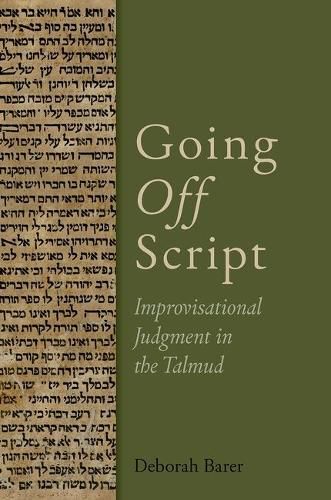
Going Off Script offers a novel explanation of what it means to act lifnim mi-shurat ha-din (within the line of the law). Tracing the development of this phrase within classical rabbinic literature, the book intervenes in longstanding debates over what this phrase signals about the relationship between Jewish ethics and Jewish law. Deborah Barer breaks with previous scholarship to argue that lifnim mi-shurat ha-din does not represent a particular type of moral or legal action, but rather a way of making decisions. When rabbis act lifnim mi-shurat ha-din, they improvise, deviating from established norms of behavior in order to pursue a specific, case-based outcome.
The creation of this category helps the Talmudic editors make sense of otherwise confusing accounts of rabbinic conduct. It also enables them to solve apparent conflicts between their inherited sources, thus resolving a specific set of legal and hermeneutic challenges that arise in the process of producing the Talmud. Once created, however, this category takes on a life of its own. Later generations of Talmudic readers and interpreters develop lifnim mi-shurat ha-din as a particular type of moral action, rather than as a way of making decisions, and they import those assumptions back onto their reading of the Talmudic text.
By identifying lifnim mi-shurat ha-din as a mode of decision-making, Going Off Script disentangles these later assumptions from the textual record, clarifying the extent to which, at the level of the Talmud itself, lifnim mi-shurat ha-din is a morally evaluative term. It identifies improvisation as a type of decision-making that introduces new moral possibilities, and traces how the Talmudic editors contend both with the destabilization that improvisation introduces as well as the beneficial outcomes it makes possible.
$9.00 standard shipping within Australia
FREE standard shipping within Australia for orders over $100.00
Express & International shipping calculated at checkout
Stock availability can be subject to change without notice. We recommend calling the shop or contacting our online team to check availability of low stock items. Please see our Shopping Online page for more details.
Going Off Script offers a novel explanation of what it means to act lifnim mi-shurat ha-din (within the line of the law). Tracing the development of this phrase within classical rabbinic literature, the book intervenes in longstanding debates over what this phrase signals about the relationship between Jewish ethics and Jewish law. Deborah Barer breaks with previous scholarship to argue that lifnim mi-shurat ha-din does not represent a particular type of moral or legal action, but rather a way of making decisions. When rabbis act lifnim mi-shurat ha-din, they improvise, deviating from established norms of behavior in order to pursue a specific, case-based outcome.
The creation of this category helps the Talmudic editors make sense of otherwise confusing accounts of rabbinic conduct. It also enables them to solve apparent conflicts between their inherited sources, thus resolving a specific set of legal and hermeneutic challenges that arise in the process of producing the Talmud. Once created, however, this category takes on a life of its own. Later generations of Talmudic readers and interpreters develop lifnim mi-shurat ha-din as a particular type of moral action, rather than as a way of making decisions, and they import those assumptions back onto their reading of the Talmudic text.
By identifying lifnim mi-shurat ha-din as a mode of decision-making, Going Off Script disentangles these later assumptions from the textual record, clarifying the extent to which, at the level of the Talmud itself, lifnim mi-shurat ha-din is a morally evaluative term. It identifies improvisation as a type of decision-making that introduces new moral possibilities, and traces how the Talmudic editors contend both with the destabilization that improvisation introduces as well as the beneficial outcomes it makes possible.
Search our extensive online catalogue.
