Readings Newsletter
Become a Readings Member to make your shopping experience even easier.
Sign in or sign up for free!
You’re not far away from qualifying for FREE standard shipping within Australia
You’ve qualified for FREE standard shipping within Australia
The cart is loading…


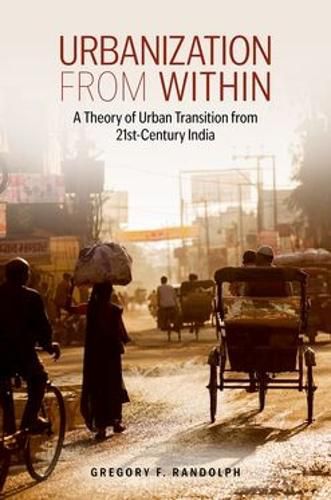
Urbanization is typically narrated as a tale of migration and industrialization--a mass exodus from rural areas to burgeoning cities with centripetal economies. Today, however, many rural settlements are not hollowing out. Rather, they are filling up and filling in, even far beyond the fringes of large metropolitan areas.In Urbanization from Within, Gregory F. Randolph challenges our conventional understanding of how humans are becoming an increasingly urban species, revealing an alternative pathway of urban transition. Drawing on research in the Indian state of Bihar, Randolph shows that agrarian villages are transforming into urban towns through internal population growth, a bootstrapped non-farm economy, and interwoven processes of social change--a phenomenon he terms urbanization from within. In this account, urbanization is still linked to rural-urban mobility, but rather than the migrant's destination, it is the migrant's origin that is urbanizing, fueled by the circular flow of people and the skills, resources, and expectations they carry and transmit to their hometowns. While rooting his study in a specific region, Randolph connects urbanization from within to a set of global forces shaping twenty-first century urban transitions in and beyond India. Urbanization from Within provides an in-depth understanding of these mechanisms as well as the consequences and future of new urbanization patterns--integrating qualitative interviews, analysis of geospatial data and large-scale surveys, econometric modeling, and insights from a wide range of disciplines. Like other pathways of urban transition, urbanization from within generates possibilities and constraints for human agency and fulfillment. To imagine a role for planning and policymaking institutions in shaping this process, Randolph provides an assessment of these tradeoffs, which are different from those generally associated with urbanization. Ultimately, Urbanization from Within fundamentally reshapes our understanding of how the world is urbanizing, with important insights for scholars, policymakers, and practitioners.
$9.00 standard shipping within Australia
FREE standard shipping within Australia for orders over $100.00
Express & International shipping calculated at checkout
Stock availability can be subject to change without notice. We recommend calling the shop or contacting our online team to check availability of low stock items. Please see our Shopping Online page for more details.
Urbanization is typically narrated as a tale of migration and industrialization--a mass exodus from rural areas to burgeoning cities with centripetal economies. Today, however, many rural settlements are not hollowing out. Rather, they are filling up and filling in, even far beyond the fringes of large metropolitan areas.In Urbanization from Within, Gregory F. Randolph challenges our conventional understanding of how humans are becoming an increasingly urban species, revealing an alternative pathway of urban transition. Drawing on research in the Indian state of Bihar, Randolph shows that agrarian villages are transforming into urban towns through internal population growth, a bootstrapped non-farm economy, and interwoven processes of social change--a phenomenon he terms urbanization from within. In this account, urbanization is still linked to rural-urban mobility, but rather than the migrant's destination, it is the migrant's origin that is urbanizing, fueled by the circular flow of people and the skills, resources, and expectations they carry and transmit to their hometowns. While rooting his study in a specific region, Randolph connects urbanization from within to a set of global forces shaping twenty-first century urban transitions in and beyond India. Urbanization from Within provides an in-depth understanding of these mechanisms as well as the consequences and future of new urbanization patterns--integrating qualitative interviews, analysis of geospatial data and large-scale surveys, econometric modeling, and insights from a wide range of disciplines. Like other pathways of urban transition, urbanization from within generates possibilities and constraints for human agency and fulfillment. To imagine a role for planning and policymaking institutions in shaping this process, Randolph provides an assessment of these tradeoffs, which are different from those generally associated with urbanization. Ultimately, Urbanization from Within fundamentally reshapes our understanding of how the world is urbanizing, with important insights for scholars, policymakers, and practitioners.
Search our extensive online catalogue.
