Readings Newsletter
Become a Readings Member to make your shopping experience even easier.
Sign in or sign up for free!
You’re not far away from qualifying for FREE standard shipping within Australia
You’ve qualified for FREE standard shipping within Australia
The cart is loading…


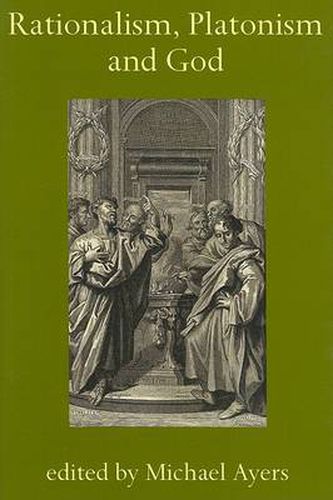
Rationalism, Platonism and God comprises three main papers on Descartes, Spinoza and Leibniz, with extensive responses. It provides a significant contribution to the exploration of the common ground of the great early-modern Rationalist theories, and an examination of the ways in which the mainstream Platonic tradition permeates these theories. John Cottingham identifies characteristically Platonic themes in Descartes’s cosmology and metaphysics, finding them associated with two distinct, even opposed attitudes to nature and the human condition, one ancient and ‘contemplative’, the other modern and ‘controlling’. He finds the same tension in Descartes’s moral theory, and believes that it remains unresolved in present-day ethics. Was Spinoza a Neoplatonist theist, critical Cartesian, or naturalistic materialist? Michael Ayers argues that he was all of these. Analysis of his system reveals how Spinoza employed Neoplatonist monism against Descartes’s Platonist pluralism. Yet the terminology - like the physics - is Cartesian. And within this Platonic-Cartesian shell Spinoza developed a rigorously naturalistic metaphysics and even, Ayers claims, an effectually empiricist epistemology. Robert Merrihew Adams focuses on the Rationalists’ arguments for the Platonist, anti-Empiricist principle of ‘the priority of the perfect’, i.e. the principle that finite attributes are to be understood through corresponding perfections of God, rather than the reverse. He finds the given arguments unsatisfactory but stimulating, and offers a development of one of Leibniz’s for consideration. These papers receive informed and constructive criticism and development at the hands of, respectively, Douglas Hedley, Sarah Hutton and Maria Rosa Antognazza.
$9.00 standard shipping within Australia
FREE standard shipping within Australia for orders over $100.00
Express & International shipping calculated at checkout
Stock availability can be subject to change without notice. We recommend calling the shop or contacting our online team to check availability of low stock items. Please see our Shopping Online page for more details.
Rationalism, Platonism and God comprises three main papers on Descartes, Spinoza and Leibniz, with extensive responses. It provides a significant contribution to the exploration of the common ground of the great early-modern Rationalist theories, and an examination of the ways in which the mainstream Platonic tradition permeates these theories. John Cottingham identifies characteristically Platonic themes in Descartes’s cosmology and metaphysics, finding them associated with two distinct, even opposed attitudes to nature and the human condition, one ancient and ‘contemplative’, the other modern and ‘controlling’. He finds the same tension in Descartes’s moral theory, and believes that it remains unresolved in present-day ethics. Was Spinoza a Neoplatonist theist, critical Cartesian, or naturalistic materialist? Michael Ayers argues that he was all of these. Analysis of his system reveals how Spinoza employed Neoplatonist monism against Descartes’s Platonist pluralism. Yet the terminology - like the physics - is Cartesian. And within this Platonic-Cartesian shell Spinoza developed a rigorously naturalistic metaphysics and even, Ayers claims, an effectually empiricist epistemology. Robert Merrihew Adams focuses on the Rationalists’ arguments for the Platonist, anti-Empiricist principle of ‘the priority of the perfect’, i.e. the principle that finite attributes are to be understood through corresponding perfections of God, rather than the reverse. He finds the given arguments unsatisfactory but stimulating, and offers a development of one of Leibniz’s for consideration. These papers receive informed and constructive criticism and development at the hands of, respectively, Douglas Hedley, Sarah Hutton and Maria Rosa Antognazza.
Search our extensive online catalogue.
