Readings Newsletter
Become a Readings Member to make your shopping experience even easier.
Sign in or sign up for free!
You’re not far away from qualifying for FREE standard shipping within Australia
You’ve qualified for FREE standard shipping within Australia
The cart is loading…


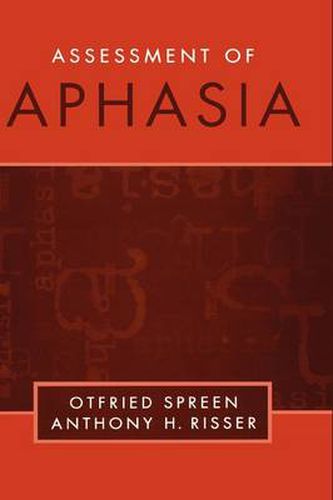
In this book, Spreen and Risser present a comprehensive, critical review of available methods for the assessment of aphasia and related disorders in adults and children. The authors explore test instruments and approaches that have been used traditionally for the diagnosis of aphasia, ranging from bedside screening and ratings, to tests of specific aspects of language, and to comprehensive and psychometrically standardised aphasia batteries. Coverage of other methods reflects newer trends, including the areas of functional communication, testing of bilingual patients, psycholinguistic approaches, and pragmatic and discourse-related aspects of language in everyday life. The authors also examine the expansion of language assessment to individuals with non-aphasic neurological disorders, such as patients with traumatic brain injury, lesions of the right hemisphere, the healthy elderly, and individuals with dementia. Taking a flexible and empirical approach to the assessment process in their own clinical practice, Spreen and Risser review numerous test instruments and their source for professionals and students-in-training to choose from in their own use.
$9.00 standard shipping within Australia
FREE standard shipping within Australia for orders over $100.00
Express & International shipping calculated at checkout
Stock availability can be subject to change without notice. We recommend calling the shop or contacting our online team to check availability of low stock items. Please see our Shopping Online page for more details.
In this book, Spreen and Risser present a comprehensive, critical review of available methods for the assessment of aphasia and related disorders in adults and children. The authors explore test instruments and approaches that have been used traditionally for the diagnosis of aphasia, ranging from bedside screening and ratings, to tests of specific aspects of language, and to comprehensive and psychometrically standardised aphasia batteries. Coverage of other methods reflects newer trends, including the areas of functional communication, testing of bilingual patients, psycholinguistic approaches, and pragmatic and discourse-related aspects of language in everyday life. The authors also examine the expansion of language assessment to individuals with non-aphasic neurological disorders, such as patients with traumatic brain injury, lesions of the right hemisphere, the healthy elderly, and individuals with dementia. Taking a flexible and empirical approach to the assessment process in their own clinical practice, Spreen and Risser review numerous test instruments and their source for professionals and students-in-training to choose from in their own use.
Search our extensive online catalogue.
