Readings Newsletter
Become a Readings Member to make your shopping experience even easier.
Sign in or sign up for free!
You’re not far away from qualifying for FREE standard shipping within Australia
You’ve qualified for FREE standard shipping within Australia
The cart is loading…


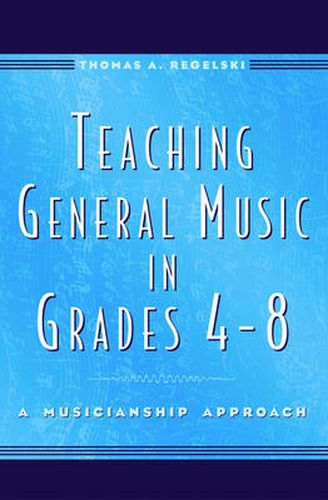
Teaching General Music in Grades 4-8: A Musicianship Approach is an ideal core text for both elementary and middle school general music methods courses. It offers unique coverage that bridges the traditional gap between these two courses. Author Thomas A. Regelski discusses the important physical, psychological, cognitive, and social developmental changes that occur in students in grades 4-8 (ages 9-14) and the implications of these changes for instruction in a variety of school organizational formats. Offering music educators both broad and detailed guidelines to fit the needs of this challenging age group, he takes a musicianship approach that regards general musical classes for grades 4-8 as an apprenticeship for lifelong musical involvement. The book establishes a rationale for general music education and then introduces an Action Learning Model, which is based on current research in many disciplines, including a praxial theory of music education. This model focuses on musical learning and skills that have real-life applications and lifelong consequences. It treats classes as musicianship laboratories in which fundamental musicianship skills are explored and developed in conjunction with holistic musical actions involving composing, performing, singing, and listening.
Teaching General Music in Grades 4-8: A Musicianship Approach offers protocols composed of detailed principles and guidelines that allow instructors to design their own lessons and tailor them to suit numerous conditions, including local curriculum, resources, and classroom size and layout. Each chapter ends with a down-to-earth Nuts ‘n’ Bolts section containing advice and recommendations that help teachers implement lessons. A glossary of key terms and ideas in music education is also included. Appendices provide a model curriculum, resources, and tips for using MIDI-based instruction and software.
$9.00 standard shipping within Australia
FREE standard shipping within Australia for orders over $100.00
Express & International shipping calculated at checkout
Stock availability can be subject to change without notice. We recommend calling the shop or contacting our online team to check availability of low stock items. Please see our Shopping Online page for more details.
Teaching General Music in Grades 4-8: A Musicianship Approach is an ideal core text for both elementary and middle school general music methods courses. It offers unique coverage that bridges the traditional gap between these two courses. Author Thomas A. Regelski discusses the important physical, psychological, cognitive, and social developmental changes that occur in students in grades 4-8 (ages 9-14) and the implications of these changes for instruction in a variety of school organizational formats. Offering music educators both broad and detailed guidelines to fit the needs of this challenging age group, he takes a musicianship approach that regards general musical classes for grades 4-8 as an apprenticeship for lifelong musical involvement. The book establishes a rationale for general music education and then introduces an Action Learning Model, which is based on current research in many disciplines, including a praxial theory of music education. This model focuses on musical learning and skills that have real-life applications and lifelong consequences. It treats classes as musicianship laboratories in which fundamental musicianship skills are explored and developed in conjunction with holistic musical actions involving composing, performing, singing, and listening.
Teaching General Music in Grades 4-8: A Musicianship Approach offers protocols composed of detailed principles and guidelines that allow instructors to design their own lessons and tailor them to suit numerous conditions, including local curriculum, resources, and classroom size and layout. Each chapter ends with a down-to-earth Nuts ‘n’ Bolts section containing advice and recommendations that help teachers implement lessons. A glossary of key terms and ideas in music education is also included. Appendices provide a model curriculum, resources, and tips for using MIDI-based instruction and software.
Search our extensive online catalogue.
