Readings Newsletter
Become a Readings Member to make your shopping experience even easier.
Sign in or sign up for free!
You’re not far away from qualifying for FREE standard shipping within Australia
You’ve qualified for FREE standard shipping within Australia
The cart is loading…


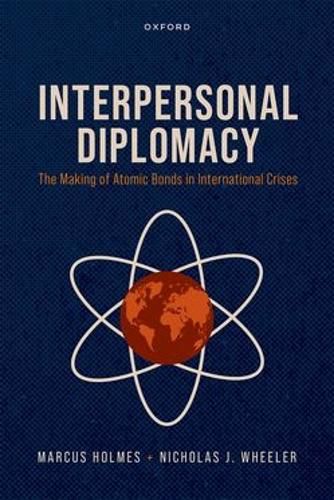
Interpersonal Diplomacy offers a pioneering theory of how emotional connection and trust between world leaders can shape the outcomes of international crises, especially those involving nuclear weapons. Drawing on microsociological theory, particularly Randall Collins' theory of interaction rituals, Holmes and Wheeler show how interpersonal dynamics-such as emotional energy, mutual focus of attention, and bodily co-presence-can foster social bonds that transform adversarial relationships. Challenging dominant structural and psychological explanations of crisis diplomacy, the book demonstrates that leader-to-leader interactions can decisively alter the trajectory of high-stakes confrontations. Through rich case studies-including the relationship between John F. Kennedy and Nikita Khrushchev during the Berlin Crisis and Cuban Missile Crisis, and the interpersonal diplomacy between Indian and Pakistani leaders Rajiv Gandhi, Zia-ul-Haq, Benazir Bhutto, and V.P. Singh, the authors trace how trust was built, tested, and sometimes thwarted. It also explores how leaders may use written communication or virtual technologies to replicate elements of face-to-face diplomacy in contexts where physical meetings are not possible. Timely and theoretically innovative, the book provides scholars and practitioners with a new framework for understanding how human relationships shape the prospects for peace and the future of international order.
$9.00 standard shipping within Australia
FREE standard shipping within Australia for orders over $100.00
Express & International shipping calculated at checkout
Stock availability can be subject to change without notice. We recommend calling the shop or contacting our online team to check availability of low stock items. Please see our Shopping Online page for more details.
Interpersonal Diplomacy offers a pioneering theory of how emotional connection and trust between world leaders can shape the outcomes of international crises, especially those involving nuclear weapons. Drawing on microsociological theory, particularly Randall Collins' theory of interaction rituals, Holmes and Wheeler show how interpersonal dynamics-such as emotional energy, mutual focus of attention, and bodily co-presence-can foster social bonds that transform adversarial relationships. Challenging dominant structural and psychological explanations of crisis diplomacy, the book demonstrates that leader-to-leader interactions can decisively alter the trajectory of high-stakes confrontations. Through rich case studies-including the relationship between John F. Kennedy and Nikita Khrushchev during the Berlin Crisis and Cuban Missile Crisis, and the interpersonal diplomacy between Indian and Pakistani leaders Rajiv Gandhi, Zia-ul-Haq, Benazir Bhutto, and V.P. Singh, the authors trace how trust was built, tested, and sometimes thwarted. It also explores how leaders may use written communication or virtual technologies to replicate elements of face-to-face diplomacy in contexts where physical meetings are not possible. Timely and theoretically innovative, the book provides scholars and practitioners with a new framework for understanding how human relationships shape the prospects for peace and the future of international order.
Search our extensive online catalogue.
