Readings Newsletter
Become a Readings Member to make your shopping experience even easier.
Sign in or sign up for free!
You’re not far away from qualifying for FREE standard shipping within Australia
You’ve qualified for FREE standard shipping within Australia
The cart is loading…


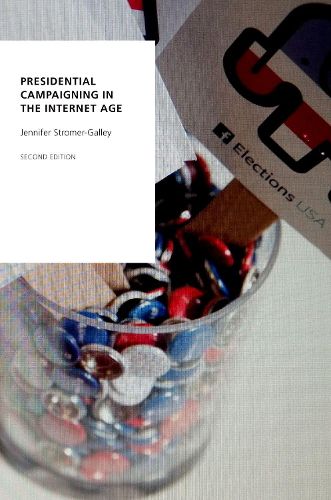
As the plugged-in presidential campaign has arguably reached maturity, Presidential Campaigning in the Internet Age challenges popular claims about the democratizing effect of Digital Communication Technologies (DCTs). Analyzing campaign strategies, structures, and tactics from the past six presidential election cycles, Stromer-Galley reveals how, for all their vaunted inclusivity and tantalizing promise of increased two-way communication between candidates and the individuals who support them, DCTs have done little to change the fundamental dynamics of campaigns. The expansion of new technologies has presented candidates with greater opportunities to micro-target potential voters, cheaper and easier ways to raise money, and faster and more innovative ways to respond to opponents. The need for communication control and management, however, has made campaigns slow and loathe to experiment with truly interactive internet communication technologies.
Citizen involvement in the campaign historically has been and, as this book shows, continues to be a means to an end: winning the election for the candidate. For all the proliferation of apps to download, polls to click, videos to watch, and messages to forward, the decidedly undemocratic view of controlled interactivity is how most campaigns continue to operate.
In the fully revised second edition, Presidential Campaigning in the Internet Age examines election cycles from 1996, when the World Wide Web was first used for presidential campaigning, through 2016 when campaigns had the full power of advertising on social media sites. As the book charts changes in internet communication technologies, it shows how, even as campaigns have moved from a mass mediated to a networked paradigm, the possibilities these shifts in interactivity seem to promise for citizen input and empowerment remain farther than a click away.
$9.00 standard shipping within Australia
FREE standard shipping within Australia for orders over $100.00
Express & International shipping calculated at checkout
As the plugged-in presidential campaign has arguably reached maturity, Presidential Campaigning in the Internet Age challenges popular claims about the democratizing effect of Digital Communication Technologies (DCTs). Analyzing campaign strategies, structures, and tactics from the past six presidential election cycles, Stromer-Galley reveals how, for all their vaunted inclusivity and tantalizing promise of increased two-way communication between candidates and the individuals who support them, DCTs have done little to change the fundamental dynamics of campaigns. The expansion of new technologies has presented candidates with greater opportunities to micro-target potential voters, cheaper and easier ways to raise money, and faster and more innovative ways to respond to opponents. The need for communication control and management, however, has made campaigns slow and loathe to experiment with truly interactive internet communication technologies.
Citizen involvement in the campaign historically has been and, as this book shows, continues to be a means to an end: winning the election for the candidate. For all the proliferation of apps to download, polls to click, videos to watch, and messages to forward, the decidedly undemocratic view of controlled interactivity is how most campaigns continue to operate.
In the fully revised second edition, Presidential Campaigning in the Internet Age examines election cycles from 1996, when the World Wide Web was first used for presidential campaigning, through 2016 when campaigns had the full power of advertising on social media sites. As the book charts changes in internet communication technologies, it shows how, even as campaigns have moved from a mass mediated to a networked paradigm, the possibilities these shifts in interactivity seem to promise for citizen input and empowerment remain farther than a click away.
Search our extensive online catalogue.
