Readings Newsletter
Become a Readings Member to make your shopping experience even easier.
Sign in or sign up for free!
You’re not far away from qualifying for FREE standard shipping within Australia
You’ve qualified for FREE standard shipping within Australia
The cart is loading…


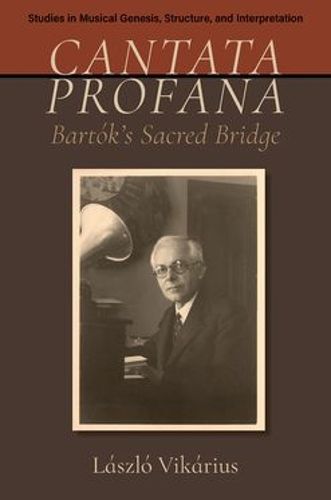
Hungarian composer Bela Bartok declared his Cantata profana, composed in 1930 and premiered in London in 1934, his "credo," the composition of which was inseparable from the history of his involvement with folklore. Not only was Bartok one of the twentieth century's most important composers, he was also one of the founders of comparative musicology, the precursor to the field of ethnomusicology. His collection and analytical studies of Hungarian, Romanian, and Slovak folk musics shaped his distinctive musical style, as well as complex scholarly publications. In this volume of the Studies in Musical Genesis, Structure, and Interpretation series, Laszlo Vikarius, a leading authority on Bartok, uncovers the many layers of ethnographic, historical, and personal meaning embedded in the Cantata profana. The work's libretto was based on a Romanian folk ballad from his collection, and the mystical story of a hunter's nine sons who turn into stags--never to return home--was close to the composer's heart. Vikarius analyzes the origins of the piece, rooted in one of Bartok's most intensive periods of collecting activities in Transylvania just before the outbreak of World War I. The multi-ethnic folkloric landscape of "historic" Hungary (part of Austro-Hungary at the time) is embodied by the source materials for Cantata profana that survive in full to be analyzed, from the sketches to the various translations of the libretto. As Vikarius demonstrates, the choice of a Romanian winter solstice ceremonial text as libretto for Cantata profana combines Bartok's folklorism with a markedly neoclassical allusion to J. S. Bach's St Matthew Passion and is necessarily underpinned by the severe criticism Bartok faced because of his interest in and work on Romanian folklore. Throughout the book, Vikarius reveals numerous hidden details that prove crucial to the concept of the work and explores how its ideologically charged text underlines the aesthetic concept behind the musical decisions.
$9.00 standard shipping within Australia
FREE standard shipping within Australia for orders over $100.00
Express & International shipping calculated at checkout
Stock availability can be subject to change without notice. We recommend calling the shop or contacting our online team to check availability of low stock items. Please see our Shopping Online page for more details.
Hungarian composer Bela Bartok declared his Cantata profana, composed in 1930 and premiered in London in 1934, his "credo," the composition of which was inseparable from the history of his involvement with folklore. Not only was Bartok one of the twentieth century's most important composers, he was also one of the founders of comparative musicology, the precursor to the field of ethnomusicology. His collection and analytical studies of Hungarian, Romanian, and Slovak folk musics shaped his distinctive musical style, as well as complex scholarly publications. In this volume of the Studies in Musical Genesis, Structure, and Interpretation series, Laszlo Vikarius, a leading authority on Bartok, uncovers the many layers of ethnographic, historical, and personal meaning embedded in the Cantata profana. The work's libretto was based on a Romanian folk ballad from his collection, and the mystical story of a hunter's nine sons who turn into stags--never to return home--was close to the composer's heart. Vikarius analyzes the origins of the piece, rooted in one of Bartok's most intensive periods of collecting activities in Transylvania just before the outbreak of World War I. The multi-ethnic folkloric landscape of "historic" Hungary (part of Austro-Hungary at the time) is embodied by the source materials for Cantata profana that survive in full to be analyzed, from the sketches to the various translations of the libretto. As Vikarius demonstrates, the choice of a Romanian winter solstice ceremonial text as libretto for Cantata profana combines Bartok's folklorism with a markedly neoclassical allusion to J. S. Bach's St Matthew Passion and is necessarily underpinned by the severe criticism Bartok faced because of his interest in and work on Romanian folklore. Throughout the book, Vikarius reveals numerous hidden details that prove crucial to the concept of the work and explores how its ideologically charged text underlines the aesthetic concept behind the musical decisions.
Search our extensive online catalogue.
