Readings Newsletter
Become a Readings Member to make your shopping experience even easier.
Sign in or sign up for free!
You’re not far away from qualifying for FREE standard shipping within Australia
You’ve qualified for FREE standard shipping within Australia
The cart is loading…


SHORTLISTED FOR THE ROYAL SOCIETY TRIVEDI SCIENCE BOOK PRIZE 2025
'A vital and important book' David Olusoga
From an award-winning historian of race, science and empire, a path-breaking and poignant history of extinction as a scientific idea, an imperial legacy and a political choice
Anyone alive today is among a tiny fraction of the once living: over 90% of species that ever existed are now extinct. How did we come to think of ourselves as survivors in a world where species can vanish forever, or as capable of pushing our planet to the verge of a sixth mass extinction?
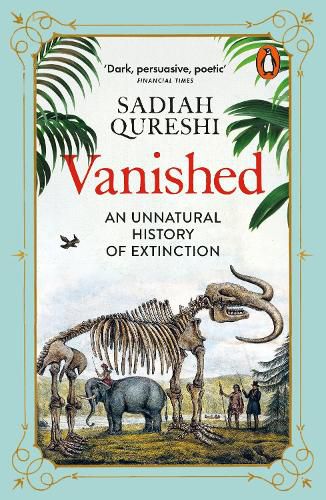
Extinction, Sadiah Qureshi shows us, is a surprisingly modern concept - and a phenomenon that's not as natural as we might think. In Europe until the late eighteenth century, species were considered perfect and unchanging creations of God. Then in the age of revolutions, scientists gathered enough fossil evidence to determine that mammoth bones, for example, were not just large elephants but a lost species that once roamed the Earth alongside ancient humans. Extinction went from being regarded as theologically dangerous to pervasive, and even inevitable.
Yet Vanished shows us that extinction is more than a scientific idea; it's a political choice that has led to devasting consequences. Europeans and Americans quickly used the notion that extinction was a natural process to justify persecution and genocide, predicting that nations from Newfoundland's Beothuk to Aboriginal Australians were doomed to die out from imperial expansion.
Exploring the tangled and unnatural histories of extinction and empire, Vanished weaves together pioneering original research and breath-taking storytelling to show us extinction is both an evolutionary process and a human act: one which illuminates our past, and may alter our future.
$9.00 standard shipping within Australia
FREE standard shipping within Australia for orders over $100.00
Express & International shipping calculated at checkout
Stock availability can be subject to change without notice. We recommend calling the shop or contacting our online team to check availability of low stock items. Please see our Shopping Online page for more details.
SHORTLISTED FOR THE ROYAL SOCIETY TRIVEDI SCIENCE BOOK PRIZE 2025
'A vital and important book' David Olusoga
From an award-winning historian of race, science and empire, a path-breaking and poignant history of extinction as a scientific idea, an imperial legacy and a political choice
Anyone alive today is among a tiny fraction of the once living: over 90% of species that ever existed are now extinct. How did we come to think of ourselves as survivors in a world where species can vanish forever, or as capable of pushing our planet to the verge of a sixth mass extinction?
Extinction, Sadiah Qureshi shows us, is a surprisingly modern concept - and a phenomenon that's not as natural as we might think. In Europe until the late eighteenth century, species were considered perfect and unchanging creations of God. Then in the age of revolutions, scientists gathered enough fossil evidence to determine that mammoth bones, for example, were not just large elephants but a lost species that once roamed the Earth alongside ancient humans. Extinction went from being regarded as theologically dangerous to pervasive, and even inevitable.
Yet Vanished shows us that extinction is more than a scientific idea; it's a political choice that has led to devasting consequences. Europeans and Americans quickly used the notion that extinction was a natural process to justify persecution and genocide, predicting that nations from Newfoundland's Beothuk to Aboriginal Australians were doomed to die out from imperial expansion.
Exploring the tangled and unnatural histories of extinction and empire, Vanished weaves together pioneering original research and breath-taking storytelling to show us extinction is both an evolutionary process and a human act: one which illuminates our past, and may alter our future.
Search our extensive online catalogue.
