Readings Newsletter
Become a Readings Member to make your shopping experience even easier.
Sign in or sign up for free!
You’re not far away from qualifying for FREE standard shipping within Australia
You’ve qualified for FREE standard shipping within Australia
The cart is loading…


The Comprehensive Guide to Computer Security, Extensively Revised with Newer Technologies, Methods, Ideas, and Examples
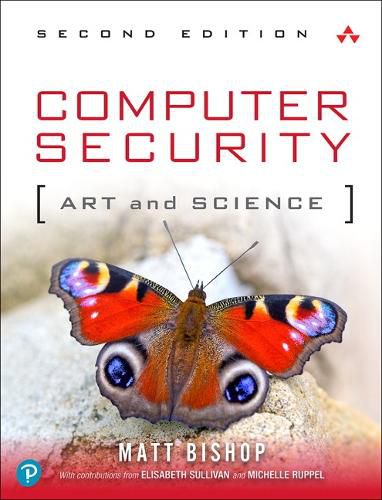
In this updated guide, University of California at Davis Computer Security Laboratory co-director Matt Bishop offers clear, rigorous, and thorough coverage of modern computer security. Reflecting dramatic growth in the quantity, complexity, and consequences of security incidents, Computer Security, Second Edition, links core principles with technologies, methodologies, and ideas that have emerged since the first edition's publication.
Writing for advanced undergraduates, graduate students, and IT professionals, Bishop covers foundational issues, policies, cryptography, systems design, assurance, and much more. He thoroughly addresses malware, vulnerability analysis, auditing, intrusion detection, and best-practice responses to attacks. In addition to new examples throughout, Bishop presents entirely new chapters on availability policy models and attack analysis.
Understand computer security goals, problems, and challenges, and the deep links between theory and practice Learn how computer scientists seek to prove whether systems are secure Define security policies for confidentiality, integrity, availability, and more Analyze policies to reflect core questions of trust, and use them to constrain operations and change Implement cryptography as one component of a wider computer and network security strategy Use system-oriented techniques to establish effective security mechanisms, defining who can act and what they can do Set appropriate security goals for a system or product, and ascertain how well it meets them Recognize program flaws and malicious logic, and detect attackers seeking to exploit them
This is both a comprehensive text, explaining the most fundamental and pervasive aspects of the field, and a detailed reference. It will help you align security concepts with realistic policies, successfully implement your policies, and thoughtfully manage the trade-offs that inevitably arise.
Register your book for convenient access to downloads, updates, and/or corrections as they become available. See inside book for details.
$9.00 standard shipping within Australia
FREE standard shipping within Australia for orders over $100.00
Express & International shipping calculated at checkout
Stock availability can be subject to change without notice. We recommend calling the shop or contacting our online team to check availability of low stock items. Please see our Shopping Online page for more details.
The Comprehensive Guide to Computer Security, Extensively Revised with Newer Technologies, Methods, Ideas, and Examples
In this updated guide, University of California at Davis Computer Security Laboratory co-director Matt Bishop offers clear, rigorous, and thorough coverage of modern computer security. Reflecting dramatic growth in the quantity, complexity, and consequences of security incidents, Computer Security, Second Edition, links core principles with technologies, methodologies, and ideas that have emerged since the first edition's publication.
Writing for advanced undergraduates, graduate students, and IT professionals, Bishop covers foundational issues, policies, cryptography, systems design, assurance, and much more. He thoroughly addresses malware, vulnerability analysis, auditing, intrusion detection, and best-practice responses to attacks. In addition to new examples throughout, Bishop presents entirely new chapters on availability policy models and attack analysis.
Understand computer security goals, problems, and challenges, and the deep links between theory and practice Learn how computer scientists seek to prove whether systems are secure Define security policies for confidentiality, integrity, availability, and more Analyze policies to reflect core questions of trust, and use them to constrain operations and change Implement cryptography as one component of a wider computer and network security strategy Use system-oriented techniques to establish effective security mechanisms, defining who can act and what they can do Set appropriate security goals for a system or product, and ascertain how well it meets them Recognize program flaws and malicious logic, and detect attackers seeking to exploit them
This is both a comprehensive text, explaining the most fundamental and pervasive aspects of the field, and a detailed reference. It will help you align security concepts with realistic policies, successfully implement your policies, and thoughtfully manage the trade-offs that inevitably arise.
Register your book for convenient access to downloads, updates, and/or corrections as they become available. See inside book for details.
Search our extensive online catalogue.
