Readings Newsletter
Become a Readings Member to make your shopping experience even easier.
Sign in or sign up for free!
You’re not far away from qualifying for FREE standard shipping within Australia
You’ve qualified for FREE standard shipping within Australia
The cart is loading…


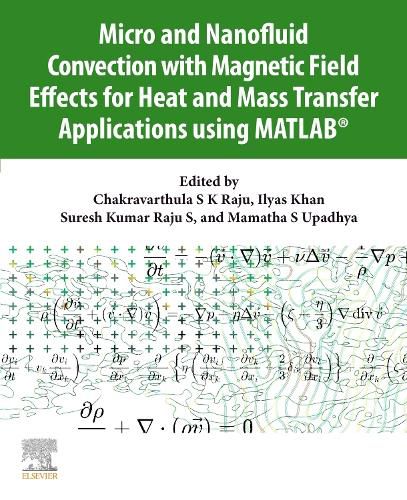
Micro and Nanofluid Convection with Magnetic Field Effects for Heat and Mass Transfer Applications using MATLAB ® examines the performance of micro and nanofluids with various physical effects such as magnetic field, slip effects, radiation and heat sources. Heat and mass transfer enhancement techniques are widely used in many applications in the heating and cooling or freezing process to make possible a reduction in weight and size or enhance performance during heat and mass exchanges. The book covers the two categories of flow techniques, active and passive. It discusses various considerations in the engineering sciences in the melting process, polymer industry and in metallurgy.
To be more precise, it may be pointed out that many metal surgical developments involve the cooling of continuous strips or filaments by drawing them through a quiescent fluid, and in that process of drawing, these strips are sometimes stretched. In all these cases, the properties of the final product depend, to a great extent, on the rate of cooling by drawing such strips in an electrically conducting fluid subject to a magnetic field and thermal radiation.
$9.00 standard shipping within Australia
FREE standard shipping within Australia for orders over $100.00
Express & International shipping calculated at checkout
Stock availability can be subject to change without notice. We recommend calling the shop or contacting our online team to check availability of low stock items. Please see our Shopping Online page for more details.
Micro and Nanofluid Convection with Magnetic Field Effects for Heat and Mass Transfer Applications using MATLAB ® examines the performance of micro and nanofluids with various physical effects such as magnetic field, slip effects, radiation and heat sources. Heat and mass transfer enhancement techniques are widely used in many applications in the heating and cooling or freezing process to make possible a reduction in weight and size or enhance performance during heat and mass exchanges. The book covers the two categories of flow techniques, active and passive. It discusses various considerations in the engineering sciences in the melting process, polymer industry and in metallurgy.
To be more precise, it may be pointed out that many metal surgical developments involve the cooling of continuous strips or filaments by drawing them through a quiescent fluid, and in that process of drawing, these strips are sometimes stretched. In all these cases, the properties of the final product depend, to a great extent, on the rate of cooling by drawing such strips in an electrically conducting fluid subject to a magnetic field and thermal radiation.
Search our extensive online catalogue.
