Readings Newsletter
Become a Readings Member to make your shopping experience even easier.
Sign in or sign up for free!
You’re not far away from qualifying for FREE standard shipping within Australia
You’ve qualified for FREE standard shipping within Australia
The cart is loading…


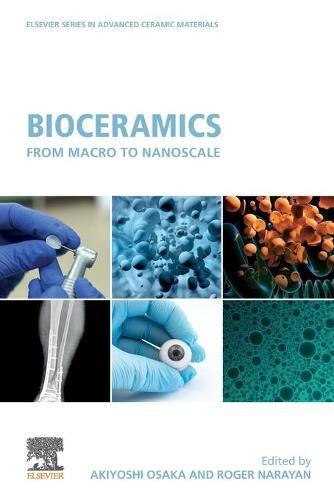
Biologically functional ceramic materials have been known about for several decades, like phosphate cements and gypsum, and they are within the zeroth generation. Modern and artificially synthesized bioceramics include amorphous materials in the Bioglass ® family that were developed in the early 1970’s and derivative glass ceramics such as Bioverit ® and Cerabone A-W ® that came in 1980’s. They are from the 2nd generation of materials, and mostly applicable to bone replacement or bone defect fillers. Since the late 1990’s, newer technologies have been introduced to the biologically functional material fields; they are the syntheses of organic-inorganic hybrids of micro- and macroscopic scales as well as nano-scales, organic fragment-covered ceramic particles of varied sizes, with light-controlling abilities to modify the frequency of light, in addition synthesis of high strength and high-tribological durability that had not been available before. With the advent of additive manufacturing technology employing lasers, electron beams, and printers, clinical materials of complicated porous structures are now easily prepared. These materials are of the 3rd generation.
This book will cover almost all kinds of such 3rd generation ceramic and ceramic-related biomaterials. This book conveys the current state-of-the-art on the science and technology of bioceramics, from nano-size dots or particles to macro-scale architectures, of a wide range of constitutions including quantum dots with peptide fragments, meso-scale therapeutic particles designed to involve drugs or genes, mesoporous organic-inorganic hybrids, nano-structured oxide layers on metals and alloys.
$9.00 standard shipping within Australia
FREE standard shipping within Australia for orders over $100.00
Express & International shipping calculated at checkout
Stock availability can be subject to change without notice. We recommend calling the shop or contacting our online team to check availability of low stock items. Please see our Shopping Online page for more details.
Biologically functional ceramic materials have been known about for several decades, like phosphate cements and gypsum, and they are within the zeroth generation. Modern and artificially synthesized bioceramics include amorphous materials in the Bioglass ® family that were developed in the early 1970’s and derivative glass ceramics such as Bioverit ® and Cerabone A-W ® that came in 1980’s. They are from the 2nd generation of materials, and mostly applicable to bone replacement or bone defect fillers. Since the late 1990’s, newer technologies have been introduced to the biologically functional material fields; they are the syntheses of organic-inorganic hybrids of micro- and macroscopic scales as well as nano-scales, organic fragment-covered ceramic particles of varied sizes, with light-controlling abilities to modify the frequency of light, in addition synthesis of high strength and high-tribological durability that had not been available before. With the advent of additive manufacturing technology employing lasers, electron beams, and printers, clinical materials of complicated porous structures are now easily prepared. These materials are of the 3rd generation.
This book will cover almost all kinds of such 3rd generation ceramic and ceramic-related biomaterials. This book conveys the current state-of-the-art on the science and technology of bioceramics, from nano-size dots or particles to macro-scale architectures, of a wide range of constitutions including quantum dots with peptide fragments, meso-scale therapeutic particles designed to involve drugs or genes, mesoporous organic-inorganic hybrids, nano-structured oxide layers on metals and alloys.
Search our extensive online catalogue.
