

Read an extract of Readings bookseller Tamuz Ellazam’s conversation with Raidah Shah Idil about her book, How to Free a Jinn, the winner of The Readings Children’s Prize 2025!
You can listen to their full conversation and hear about the other 2025 winners of The Readings Prizes on The Readings Podcast.
Tamuz: Hi Raidah, thank you so much for joining me and congratulations on winning The Readings Children’s Prize this year. For those of our listeners who may not know anything about your book, can you give us a brief description of the plot?
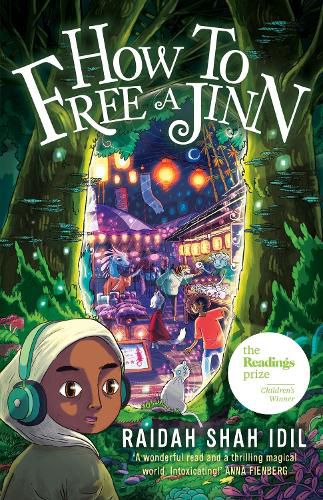
Raidah: Sure. So, How to Free a Jinn follows the adventures of Insyirah. She's a 12-year-old neurodivergent Malay-Muslim girl who was born in Malaysia and, under mysterious circumstances, moved to Sydney, Australia with her mum.
Her dad passed away when she was really young, so it's only really been her and her mum for a long time. And then one day her mum decides to move back to Malaysia because her grandma, her nenek, her mum's mother, had a bad fall and it's time to go back and look after her. And Insyirah, being an anxious kid, being neurodivergent, does not like change, and moving to Malaysia is the biggest change of all.
And if that wasn't bad enough, there's other creepy supernatural things that are happening! And Insyirah discovers that her family has this secret when it comes to jinn, and she will have to make a really important decision … That's it in a nutshell!
Tamuz: Can you please tell us a little bit about your inspiration for writing this book? It's your debut in middle grade fiction; what inspired the story?
Raidah: I think so much of Insyirah’s experience is informed by mine. Maybe not in the super supernatural way, but so many themes of migration and identity and neurodivergence; because once upon a time I was that 12-year-old kid who moved from Singapore to Sydney, and it was really tough.
Insyirah herself came to me fully formed in a dream, because when I'm pregnant I get the most bizarre, creative, incredibly vivid dreams. And thankfully, for all three of my pregnancies, they've been fairly straightforward, and I just get really happy and really creative and really hungry!
And I thought, OK, I'm having my third baby now, right? I had at the time had a four-year-old and a one-and-a-half-year-old, so if I don't finish this book by the time I give birth, when will I get the opportunity? And looking after a baby in utero, it's a lot easier than once they’re earth-side!
So that gave me the motivation, I had all these ideas, Insyirah came to me in a dream and I'm like OK, I have about nine months. Let's do this.
Tamuz: What a deadline! And you can really tell – now that you say that, it makes a lot of sense … one of the things that the judging panel could not get over is how hungry your book made us! The descriptions of the sensory are so lush, and you can feel the humidity, but you can't taste the food, and that's cruel!
The descriptions are so vivid and so delicious. It now makes a lot of sense that you were having some cravings.
Raidah: Absolutely. And I was going from my favourite cafes to restaurants just drafting happily, while my younger two were either at preschool or being looked after by their grandma. So, I think I definitely did transmit that sensory aspect. Because it was a very sensorial experience for me as well, immersing myself in this story and really giving myself permission to just write.
And I think the fact that I was already in my late 30s by that point and I'd consumed a lot of different media; and Hanna Alkaf, she's a Malaysian author, and seeing her get published through Salaam Reads – which is now publishing my book! – it was so amazing seeing someone who looked so much like me: Malay, hijabi, also a mum. I'm like, ‘wow, she got a literary agent in the US and she got a publishing deal, maybe I can as well’.
And her advice to me when I was pregnant with my second girl, was ‘Raidah, finish your draft’ because she knew I had like 5 concurrent novels on the go! I think it was part of my anxiety around possibly being rejected, thinking ‘it's OK, I'll just keep tinkering.’ And I'm like, wait a minute, now my deadline is here. This is my time. It's my time to step into the story that's been on the backburner for years now and weave it into this adventure that I wish Little Raidah had gotten access to – back when I was a really stressed out 12-year-old hiding in the library because I was embarrassed by my Singaporean accent; I was once again a minority in a majority Islamic school. In Singapore I was the Malay minority in a Chinese majority country. And then in Malek Fahd, in that particular school, I was one of the very few non-Arabs, so I am continuously out of water. So, this feeling of being between worlds is something in my bones, you know? I’m very intimately connected to that.
And I decided, you know what? I've always loved fantasy, but the fantasy books I grew up with, none of the characters ever looked like me. I mean, I saw unicorns, elves, but I didn't get to see like a brown hijabi girl on the cover. So being able to manifest her existence, after she visited me in my dreams, it was just incredible.
Tamuz: I mean, I feel that personally and I see, when we serve children in the kids’ store, in our shops across Readings, so much of the time you see children who are looking for themselves, and to be able to say ‘here she is' – it's such a gift.
Is there an ideal reader for your book and what do you hope that your readers take away from it?
Raidah: Yeah, that's a tricky one. Who is the ideal reader? I feel like there are many ideal readers for the book. I think for one, an ideal reader could be a young Muslim kid living out in the diaspora in the West, who feels very misunderstood, who feels alone, who feels always alienated in some way, shape or form, or doesn't feel enough. You know, feeling that we have to assimilate completely and lose parts of ourselves to be loved. So I hope that this book will be a comforting hug and say no, ‘you are not the problem. You have never been the problem’ …
So that's one definitely very important ideal reader. And another would be a kid who's not Muslim, who probably hasn't met any Muslims, who doesn't have any close Muslim friends or family; who, sadly, perhaps their only exposure could be very negative and very misinformed by propaganda on the news and so on. I would love for that child to pick up my book, and that's their first true exposure to Islam in a sense, to Muslim families, to grandmas, to mums, to a fellow 12-year-old.
I would love for that to be a bridge to curiosity and compassion and to build that critical thinking skill. Like, ‘OK, wait a minute, this is not what I see on TV and this feels more true. This feels more authentic. This was written by an actual Muslim author. Maybe this is a voice that I need to pay more attention to and block out everything else that's out there.’
So, those are just two examples of children. But for adults, I guess I would say the same, like a Muslim adult out there, in the diaspora, in a really hard time, to just have this book as a comforting, soft landing – to heal that inner child, you know?
And similarly, someone like Jodi and Kate, my editors who are not Muslim, who don't come from my cultural background, but they could see something so powerful and so resonant and so relatable in these stories, and just being able to deconstruct whatever ideas that they might have had about Muslims or Muslim families, whether consciously or unconsciously.
Let us speak for ourselves, let us tell our stories, you know, let us centre our narratives. And let us show you how much our faith, our family, our culture, how much they add to our lives, and they can improve everyone else's too. Just give us a chance!
Listen to the rest of the interview on The Readings Podcast!
Tamuz Ellazam is the manager of Readings Kids and was the chair of judges for The Readings Children’s Prize 2025.
Raidah Shah Idil was born in Singapore, grew up in Sydney, Australia, studied and worked in Amman, Jordan and now lives in Petaling Jaya, Malaysia with her husband, three children and mother-in-law. How to Free a Jinn is her debut novel, recommended for ages 10+.
