

To celebrate the release of Andrew Pippos’s brilliant second novel and the announcement of this year’s winners of The Readings Prize, Readings chairman Mark Rubbo interviewed past-winner Pippos for The Readings Podcast.
Enjoy an extract of their interview below and listen to the full converstation on the Readings Podcast.

Mark: Andrew, it’s great to see you again. It’s been some years since you won The Readings Prize [for Lucky’s] and I remember you coming down for the celebration and us all loving that book. Tell us what you’ve been up to in the years since we saw you last.
Andrew: Thank you, Mark, it’s great to see you again. That was a really lovely time we had having lunch and chatting about the book. Oh, The Readings Prize, I think that might be the only prize I’ve ever won in my life! It was a very special, very special moment.
Since then, I’ve been working very hard on my next book, The Transformations, and trying to juggle work on the book with academic work at UTS [the University of Technology] in Sydney.
Mark: As we get into talking about the book, it might help people to know a bit about your background – we could do a sort of backwards CV.
Andrew: So, I’m currently a lecturer in creative writing at UTS. Before that, I was a casual tutor at UTS. And then I was doing my PhD in creative writing there. And then before that period, I was a subeditor at a number of different publications. I worked at The Independent and The Guardian in London. So, I had a few years in London … And I also worked at The Australian newspaper as a subeditor in the days when The Australian was a different newspaper, I think. There was a monthly literary review supplement. The books pages were extensive. Lenore Taylor and George Megalogenis were the political reporters. So that was The Australian that I knew. I left to do a PhD, which I always knew that I would do.
It was funny, I got caught in newsrooms for a little while … In newspapers, I suppose I was something of a misfit – and the misfits in newspapers are often found on the subeditors’ desk. And that was my home. So that’s really the work history that is pertinent to The Transformations, which is a novel largely set in a newsroom.
Mark: It is. And yes, I guess that’s why I wanted to find out. Because I’ve been talking about the book with my colleague Alison, and I have to admit, we’re both besotted with this book. And one of the things Alison pointed out was just the depiction of the newsroom – all the things that were going on with it were so alive and real. And it’s sort of like a microcosm of this world, isn’t it? In your novel, I guess, the newsroom – everything comes out of that.
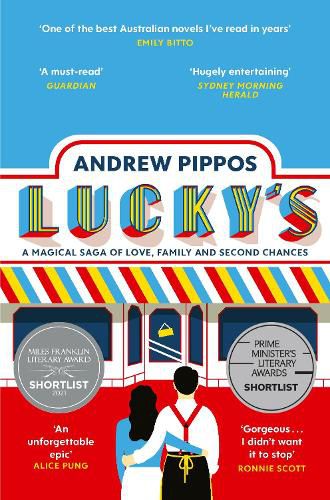
Andrew: Well, it is interesting to think about the origins of this book and how it’s related to Lucky’s. The workplace is also really important to Lucky’s. And the café-milk-bar world of Lucky’s was an institution of its time. They were popular restaurants, particularly in New South Wales and Queensland. In country towns in those states, they were a social hub. They were an institution. And they became obsolete and were replaced by a restaurant culture that’s more like the one that we have today. And that café world represented, I guess, an early phase of multiculturalism as well. That’s another thing that I was trying to do with Lucky’s and with The Transformations.
Again, you have this workplace, this social institution. In the case of The Transformations, it’s a newspaper. The everyday work was important to the representation of that setting. And I know that a lot of novels set in newsrooms often have this one story that the reporter follows, almost like a detective story. That’s not what I wanted to do with this novel. I wanted to have lots of different stories. I wanted to show the way that every day is at a newspaper; every day these people in this room begin again in their work of describing the world, describing the city, describing the country.
Mark: And in the book, I was interested in how you’re talking about the Greek regional restaurants, the cafés. The backdrop to the newspaper is that we’re all aware this is a dying institution, although there’s an owner who professes that he’s not going to let it [the newspaper] die. I won’t tell what happens, but you also tackle some really big themes, a lot of themes, in the book. [There are] societal changes going on; there are relationships, different kinds of relationships; there’s sexual abuse; there’s a lot of luck going on – I think it’s amazing that you’ve actually pulled it off and it really is coherent. What were you trying to do in introducing all those different themes?
Andrew: I think the main theme is one that crosses all the various storylines of the novel. The way that I think of it, I have this primary plotline, the love story between George and Cassandra, who both work at the national newspaper. And then two subplots: one is to do with a teenage girl called Elektra, who is George’s daughter, and the story about the fate of the national newspaper is the other subplot. And I guess the theme of change, the theme of endings and beginnings, crosses all of those plotlines.
Mark: Yeah, there’s all these things going on and you think, this is disastrous, but it’s a very positive book in many ways, I found. Did you want to write a positive novel?
Andrew: I did, I did, I wanted to. I wanted to write something that did explore some of the darker elements of life – grief, the effects of really malignant personalities on people; greed; the extraordinary cost of living, in all of its senses, in Australian cities. But to me, there’s something about the sort of love between the characters that I always gravitated towards. That sort of kindness and grace, it just seemed like a natural ending for the characters.
Mark: Well, you know, we’re living in what appear to be such dark times. It would have been easy to be sucked into presenting a very bleak situation.
Andrew: I mean, there is quite a lot of darkness in this book. And ultimately – again, like Lucky’s – it’s about these institutions in quite steep decline. And that is a world that isn’t in the world of Lucky’s. Of course, [in Lucky’s] those institutions were replaced by other institutions that were just better suited to the times in Australia. Whereas what we’re seeing now is the degradation of institutions like newspapers, various publications, universities – we could keep going with this list of institutions that are being threatened, but they’re not being replaced. They’re being broken, but there’s nothing replacing them. That is a real concern and that’s something the book doesn’t solve. It doesn’t try to solve grief or the tragedy in the book either, but the characters do learn to survive the bad stuff and enjoy the good stuff in life, all the same.
Mark Rubbo is the chairman of Readings.
Andrew Pippos is an acclaimed Australian writer and academic. His debut novel, Lucky’s, won The Readings Prize for New Australian Fiction in 2021 and was shortlisted for the Miles Franklin Literary Award and the Prime Minister’s Literary Award for Fiction in the same year. The Transformations is his superb second novel and it’s already a Readings favourite.
Listen to the rest of the interview on the Readings Podcast!
The Transformations is also our Fiction Book of the Month, and you can read head book buyer Alison Huber's review here.
