

Every year our staff vote for their favourite books of the past year. Here are the best Australian fiction books of 2025, as voted by Readings' staff!
Titles are displayed alphabetically by author.
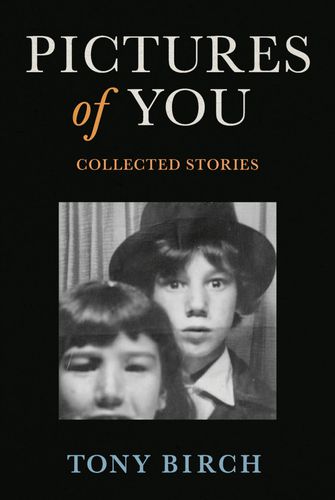
Pictures of You: Collected Stories
Tony Birch
‘If I had to pitch Tony Birch’s newest book with a single phrase, I’d just say it’s the best of the best: the best stories from across the career of one of Australia’s best working writers. Spanning three decades of publication, Pictures of You is a treasure trove of tales, filled to bursting with skilful prose, compelling characters and quiet moments of release.
Framed, in many ways, by the sombre title story – the most recent contribution included – the collection’s depth and breadth invites a reflective tone, as each individual story builds towards an understanding of Birch himself and his long-held preoccupations. Family is always central, whether it takes the form of deep sibling bonds, fierce maternal figures or, most strikingly, fathers who are drunken tyrants, fragile ghosts in old age or simply absent. In each case, Birch’s stories capture his characters at their most volatile, caught at crossroads and filled with potential …
This is a book that will find an easy place on many a bedside table.’
– This is an edited quote from Joe Murray’s review for Readings Monthly
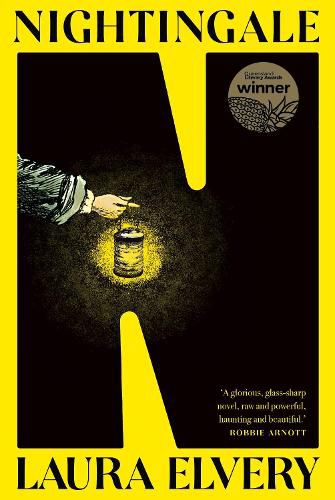
Nightingale
Laura Elvery
‘The first time we meet Florence Nightingale, it’s 1850 … The second time we meet her, it’s 1910: she’s older, frail, and near death … Memories and dreams have become indistinguishable from reality, and she never sees visitors – until one fateful summer evening, that is, when a mysterious stranger appears on her doorstep.
Silas Bradley is a man with ghosts of his own. He claims to have met Nightingale a half-century ago, during the Crimean War: now, he’s seeking answers about Jean Frawley, an elusive woman who inexplicably connects their two lives.
His quest is a window into a long-buried past. Through their exchanges, we shift between past and present, navigating dark and intricate histories. In the process, Nightingale’s character – her contradictions, determination, faith and complexity – is exposed and unravelled, and the impenetrable figure of the ‘lady with the lamp’ is humanised and made real …
The entire book is a haunting and thought-provoking achievement: a considered, poignant exploration of the many faces of Florence Nightingale, and a powerful vindication of bravery, care and women’s work.’
– This is an edited quote from Ellie Dean’s review for Readings Monthly
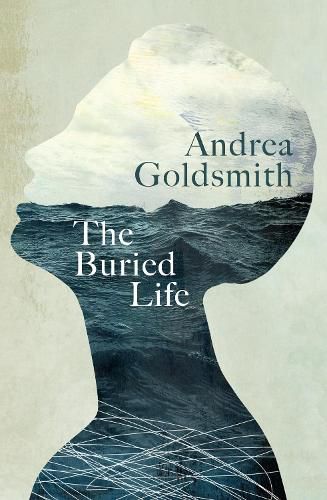
The Buried Life
Andrea Goldsmith
‘This is the ninth novel from Miles Franklin-shortlisted author and Melbourne Prize winner Andrea Goldsmith … The Buried Life is probably her finest novel, with characters with whom you can fully empathise – and a few villains whom you can despise.
Academic Adrian Moor’s field is Death Studies; it’s rather specialised, but it’s gotten him tenure at a prestigious university … In a cheese store, Adrian is entranced when he meets Laura, an accomplished town planner. However, Laura is married to Tony, a man she idolises and whom she believes is responsible for her growth as a person. In spite of this she is attracted to Adrian, to the ease with which they can converse and his uncritical acceptance of her; with Tony, she is constantly afraid that she might offend him or say or do something which he might criticise. The book’s exploration of this emotional abuse is particularly – excruciatingly – fascinating. When Tony is away for four weeks, the relationship between Adrian and Laura develops, and she starts to question Tony’s controlling behaviour …
The Buried Life is a big, terrific book that will entertain and inspire you.’
– This is an edited quote from Mark Rubbo’s review for Readings Monthly
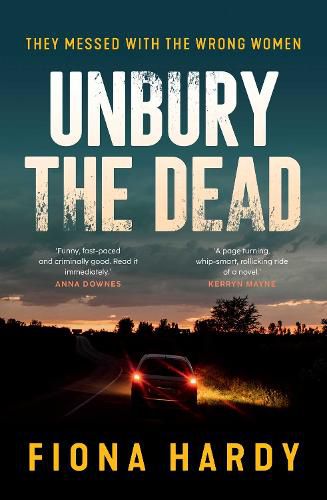
Unbury the Dead
Fiona Hardy
‘… Unbury the Dead revolves around two ‘cleaners’ (in the mafia sense of the word, not the housekeeping kind), Teddy and Alice, who are called in from their well-deserved holidays for two straightforward jobs that prove to be anything but. Alice has been hired to drive the body of the richest man in Australia to his final resting place, while Teddy is on the hunt for a disaffected young man who’s gone missing. Before too long it becomes clear the two jobs have more in common than expected, and that’s where things start to get dangerous.
An investigative-thriller-cum-road-trip-adventure that meanders delightfully through the familiar surrounds of Melbourne and regional Victoria, Unbury the Dead is a cracking mystery, but where it really shines is in the tender depiction of the ride-or-die friendship between our two protagonists … Like Alice and Teddy themselves, Unbury the Dead is sharp-edged but full of heart, distinctly funny, and seriously clever. I can’t wait to see what happens next.’
– This is an edited quote from Lian Hingee’s review for Readings Monthly
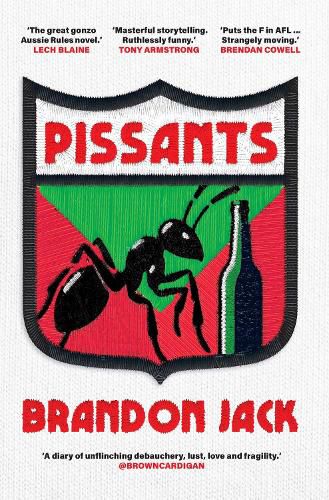
Pissants
Brandon Jack
‘If you’re a person that baulks at reading about sex, drugs, and debauchery … this is absolutely not the book for you. But if you’re up for reading about these matters … and are seeking a reading experience that is unlike any other you’ll encounter this year, Pissants is absolutely the book for you. It’s a raw, honest, and audacious take on the AFL machine that churns through so many young people in our community, and is eye-opening, eye-watering, and surprisingly emotional.
Brandon Jack (yes, the Brandon Jack who is a former Sydney Swans player and also wrote the critically acclaimed 2021 memoir, 28) has written this debut work of fiction, which leaves no detail of the club experience unexplored … [Jack builds] the picture of what might happen off the field, in the locker room and beyond, illuminating the pressures on these young men, who are all so desperate to belong and be valued, and must seek and perform that belonging and value in a hyper-masculine corporate environment, relying on corporeal talents that are only one injury or bad decision away from obsolescence. It’s intense.
… the great big heart of this book is a critical take on so many of the things I want to read about: identity, passion, culture, language, and the always unfinished work of making the self … I f***ing loved Pissants.’
– This is an edited quote from Alison Huber’s review for Readings Monthly
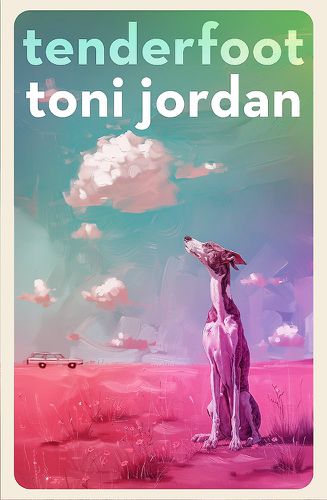
Tenderfoot
Toni Jordan
‘Tenderfoot is a poignant portrayal of Andie, a young girl growing up in Queensland in the 1970s. Based on Toni Jordan’s own childhood, it’s more personal than her previous books. It reads much like a memoir, with older Andie dipping in occasionally to speak directly to the reader with a life update on whether this dream or that piece of advice ever came to pass.
Andie is a beautifully drawn character shaped by true complexity from a young age. Her world is small – mapped out exclusively between her home, school and the dog track, which is her happy place. She loves her greyhounds with a passion and wants to live in their world and at the track forever. With no such thing as gentle parenting in her world, Andie tries to cope with the way she is parented – or not parented. Meanwhile, the greyhounds always take priority over her.
My heart was with Andie from the first page. Jordan’s depictions of her inner thoughts, the all-important school friendships and her incredibly strong will to battle through life’s harsh realities are very authentic … I devoured this book in a weekend.’
– This is an edited quote from Nicki Levy’s review for Readings Monthly
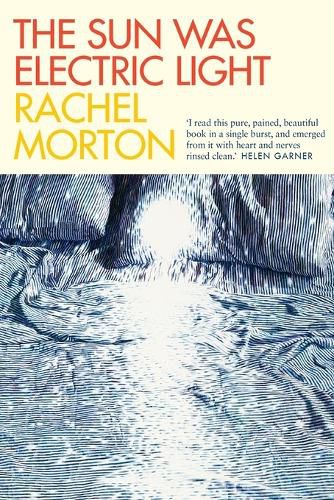
The Sun Was Electric Light
Rachel Morton
‘… The Sun Was Electric Light is a striking debut from Rachel Morton, demonstrating her capability as a fierce new literary talent. Sparse and beautifully written, Morton delivers a powerful meditation on the meaning of home, happiness, and where to turn in grief.
We follow the story of our narrator Ruth, lonely and rootless, who abandons her life in New York for the balmy streets of Guatemala. There, Ruth meets Emilie and then Carmen, drawn towards these polarised individuals for different reasons, her love for them is shaped in distinctive and incompatible ways. Steadily reconnecting with the world around her, Ruth develops deep relationships both to people and place, grappling with her attachment to each woman and the volcanic lake around which their life is centred.
… This narrative is unique and pleasingly unpredictable … The strength of this book is its ability to unmask the most subtle of human experiences simply and succinctly, drawing readers deep into the heart of Ruth’s Guatemalan home.’
– This is an edited quote from Aideen Gallagher’s review for Readings Monthly
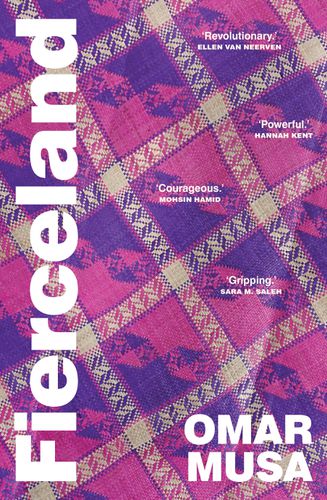
Fierceland
Omar Musa
‘Yusuf is in the vanguard of Malaysia’s economic boom and when he takes [his children] Roz and Harun on a business expedition deep into the jungles of Borneo, [they] begin to discover the dark side of his wealth – the destruction of ancient trees and ecosystems to make way for monolithic palm plantations.
As Roz and Harun reckon with this shocking truth, their relationship begins to splinter and their lives take divergent turns, sending them to different parts of the globe. A family tragedy sends them back to Borneo and forces them to confront their complicity in the environmental destruction of their homeland.
… While Musa propels the story forward with more straightforward narrative prose, the chapters are interwoven with poetry and verse. Musa started out as a poet and performer and there is real lyric beauty and rhythm in this writing.
This is an ambitious and important novel that interweaves Malaysian history, environmental degradation, cultural heritage, artistic endeavours and fucked-up families. And that description doesn’t even scratch the surface …’
– This is an edited quote from Joe Rubbo’s review for Readings Monthly

The Transformations
Andrew Pippos
‘… this is a truly superb second novel which cements Pippos’s reputation as one of our most exciting chroniclers of the Australian experience and psyche … The novel is set in and around the newsroom of a fictional daily newspaper, The National, at a time of rapid change in the print media industry during the 2010s. George Desoulis is a subeditor in his mid-30s. He keeps to himself, admires his colleagues, believes in his work and the labour of the journalist’s calling. A late-night encounter with a colleague, Cassandra, marks a turning point in his life, as he finds an unexpected but intense connection with this woman who has children and a marriage and an agreed set of parameters with her husband around non-monogamy …
The characters in The Transformations are so clearly imagined, and the attachment I developed for them is one of the reasons I couldn’t put this book down: they’re flawed and lovable and affecting in ways that are familiar and emotionally charged, while Pippos’s particular skill for capturing the nuance of Australia’s migrant experience through the generations is again on show here … One of the great books and reading highlights of my 2025 …’
– This is an edited quote from Alison Huber’s review for Readings Monthly
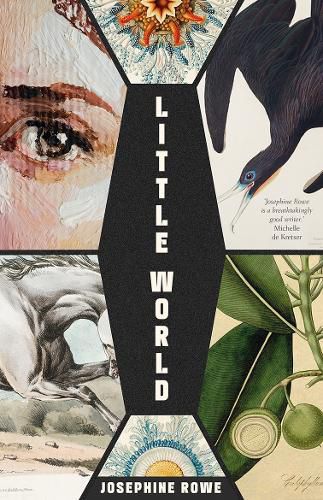
Little World
Josephine Rowe
‘In 1950, a saint arrives at Orrin Bird’s house in a box. It is a box, he realises, that he built years ago, made for mundane household storage. But the saint is not mundane. She is only a child, incorruptible, so she may have died years or centuries ago. Her name, canonical status, and story are unknown. Yet, we soon discover, she is conscious, touching the lives of those she encounters as they handle her box, her body, the remnants of her extinguished life.
Josephine Rowe’s novel works as a eulogy, elegy, and prayer to this life. Rowe is preoccupied with endings, with three-part acts. Is the world ending yet? Is this the beginning of the end, or the end of the beginning? What does it mean for things to go on far beyond where they’re supposed to end? What does it mean for this saint’s body to remain, when her life does not? … Half a century later, Mathilde wonders the same thing. She has been road tripping across Australia, but here, discovering the saint still in her box, she pauses. Orrin Bird is long gone. But does this represent an end for her too? Or another beginning?’
– This is an edited quote from Teddy Peak’s review for Readings Monthly
🏆 Other 2025 releases highly recommended by our staff are I Want Everything by Dominic Amerena, winner of The Readings New Australian Fiction Prize 2025, and The Confidence Woman by Sophie Quick, which was shortlisted for the prize. You can revisit the rest of the 2025 shortlist here.
There were also several wonderful books of Australian poetry released this year, including The Rot by Evelyn Araluen, A Savage Turn by Luke Patterson, beautiful changelings by Maxine Beneba Clarke, The Nightmare Sequence by Omar Sakr, illustrated by Safdar Ahmed, and Two Hundred Million Musketeers by Readings bookseller Ender Başkan!
Don't miss the best international fiction books of 2025!
