Readings Newsletter
Become a Readings Member to make your shopping experience even easier.
Sign in or sign up for free!
You’re not far away from qualifying for FREE standard shipping within Australia
You’ve qualified for FREE standard shipping within Australia
The cart is loading…


In Tibet, vajra songs became popular when Milarepa gave teachings in that style to his disciples. His example influenced all Tibetan Buddhist schools, particularly the Kagyu lineages.
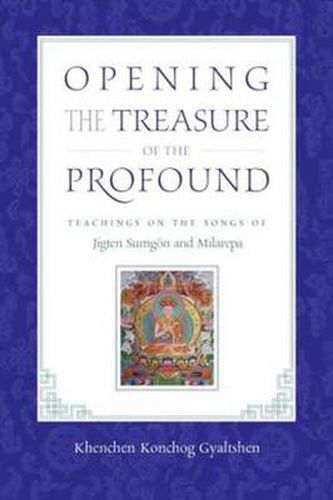
In Tibet, vajra songs became popular when Milarepa gave teachings in that style to his disciples. His example influenced all Tibetan Buddhist schools, particularly the Kagyu lineages. People commonly memorized such songs and sang them with beautiful melodies. But vajra songs are much more than pleasant tunes or ordinary poetry. A vajra song reflects the enlightened mind of its author by encapsulating precisely profound meaning in just a few words. Thus, it can be difficult for the unenlightened to penetrate their meaning.
Khenchen Konchog Gyaltshen learned to sing vajra songs at his mother’s knee. Later in life, he learned of their profound meaning from masters of Tibetan Buddhism, which allowed him to finally experience their depth in solitary retreat. Rinpoche brings this tradition into a Western context by translating songs composed by iconic Buddhist figures and explaining them in contemporary terms.
Rinpoche presents the outer and inner meaning of nine vajra songs by Milarepa (ca. 1052-1135) and Jigten Sumg n (1143-1217). He describes the Buddhist path of wisdom and compassion that leads to ultimate peace and happiness, and shows how to develop our mental qualities. In ancient times, these teachings were given to help others reach spiritual maturity. Here, we are invited into the world of transmission from master to disciple in order to discover truth for ourselves-to open the eye of wisdom that reveals the mind that cannot be seen.
$9.00 standard shipping within Australia
FREE standard shipping within Australia for orders over $100.00
Express & International shipping calculated at checkout
Stock availability can be subject to change without notice. We recommend calling the shop or contacting our online team to check availability of low stock items. Please see our Shopping Online page for more details.
In Tibet, vajra songs became popular when Milarepa gave teachings in that style to his disciples. His example influenced all Tibetan Buddhist schools, particularly the Kagyu lineages.
In Tibet, vajra songs became popular when Milarepa gave teachings in that style to his disciples. His example influenced all Tibetan Buddhist schools, particularly the Kagyu lineages. People commonly memorized such songs and sang them with beautiful melodies. But vajra songs are much more than pleasant tunes or ordinary poetry. A vajra song reflects the enlightened mind of its author by encapsulating precisely profound meaning in just a few words. Thus, it can be difficult for the unenlightened to penetrate their meaning.
Khenchen Konchog Gyaltshen learned to sing vajra songs at his mother’s knee. Later in life, he learned of their profound meaning from masters of Tibetan Buddhism, which allowed him to finally experience their depth in solitary retreat. Rinpoche brings this tradition into a Western context by translating songs composed by iconic Buddhist figures and explaining them in contemporary terms.
Rinpoche presents the outer and inner meaning of nine vajra songs by Milarepa (ca. 1052-1135) and Jigten Sumg n (1143-1217). He describes the Buddhist path of wisdom and compassion that leads to ultimate peace and happiness, and shows how to develop our mental qualities. In ancient times, these teachings were given to help others reach spiritual maturity. Here, we are invited into the world of transmission from master to disciple in order to discover truth for ourselves-to open the eye of wisdom that reveals the mind that cannot be seen.
Search our extensive online catalogue.
