Readings Newsletter
Become a Readings Member to make your shopping experience even easier.
Sign in or sign up for free!
You’re not far away from qualifying for FREE standard shipping within Australia
You’ve qualified for FREE standard shipping within Australia
The cart is loading…


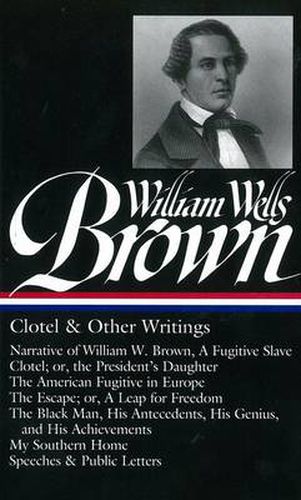
Born a slave and kept functionally illiterate until he escaped at age nineteen, William Wells Brown (1814-1884) refashioned himself first as an agent of the Underground Railroad and then as an antislavery activist and self-taught orator and author, eventually becoming a foundational figure of African American literature.
For his bicentennial, The Library of America presents the most comprehensive edition of Brown’s writing ever published, an extraordinary collection of landmark works that together give voice to his passionate commitment to freedom and equality.
A gripping account of his childhood, life in slavery, and eventual escape, Brown’s first published book, Narrative of William W. Brown, A Fugitive Slave (1847), was an immediate bestseller, with four editions in its first year.
Like Frederick Douglass’s Narrative, the only slave autobiography to sell more copies before the Civil War, it unmasks the hypocrisy of Christian slaveholders and exposes with startling intensity the violence of slave life.
Clotel; or, the President’s Daughter (1853), the first novel written by an African American and Brown’s most ambitious work, purports to be the history of Thomas Jefferson’s black daughters and granddaughters.
Dramatizing the victimization of black women under slavery, the novel measures the yawning chasm between America’s founding ideals and the brutal realities of bondage.
Having traveled to Europe in 1849, Brown elected to remain there after the passage of the Fugitive Slave Act of 1950, not returning to America until 1854.
The American Fugitive in Europe- Sketches of Places and People Abroad (1855) is the expanded version of Brown’s pioneering travelogue, recounting his initial trip to Paris as a delegate to the International Peace Congress and his extensive tours through the United Kingdom as an antislavery lecturer.
The first published play by an African American, Brown’s The Escape; or, A Leap for Freedom (1858) portrays a slave woman’s escape from the sexual aggression of her white master.
Published in the autumn of 1862 as the nation awaited President Lincoln’s final Emancipation Proclamation, The Black Man, His Antecedents, His Genius, and His Achievements highlights black men of accomplishment and influence whose lives ‘surmounted the many obstacles which slavery and prejudice have thrown in their way.’
My Southern Home- or, The South and Its People (1880), Brown’s last memoir, explores the complex relationships and interrelationships between blacks and whites in the South during Reconstruction.
The volume is rounded out with eighteen speeches and letters from Brown’s public career, most previously uncollected, dealing with abolition, party politics, black history, Reconstruction and civil rights, and temperance.
Detailed explanatory notes identify Brown’s many quotations and allusions throughout.
Ezra Greenspan holds the Edmund J. and Louise W. Kahn Chair in Humanities and is professor of English at Southern Methodist University.
He is the editor of William Wells Brown- A Reader and the author of William Wells Brown- An African American Life.
He is a founding editor of the journal Book History.
$9.00 standard shipping within Australia
FREE standard shipping within Australia for orders over $100.00
Express & International shipping calculated at checkout
Stock availability can be subject to change without notice. We recommend calling the shop or contacting our online team to check availability of low stock items. Please see our Shopping Online page for more details.
Born a slave and kept functionally illiterate until he escaped at age nineteen, William Wells Brown (1814-1884) refashioned himself first as an agent of the Underground Railroad and then as an antislavery activist and self-taught orator and author, eventually becoming a foundational figure of African American literature.
For his bicentennial, The Library of America presents the most comprehensive edition of Brown’s writing ever published, an extraordinary collection of landmark works that together give voice to his passionate commitment to freedom and equality.
A gripping account of his childhood, life in slavery, and eventual escape, Brown’s first published book, Narrative of William W. Brown, A Fugitive Slave (1847), was an immediate bestseller, with four editions in its first year.
Like Frederick Douglass’s Narrative, the only slave autobiography to sell more copies before the Civil War, it unmasks the hypocrisy of Christian slaveholders and exposes with startling intensity the violence of slave life.
Clotel; or, the President’s Daughter (1853), the first novel written by an African American and Brown’s most ambitious work, purports to be the history of Thomas Jefferson’s black daughters and granddaughters.
Dramatizing the victimization of black women under slavery, the novel measures the yawning chasm between America’s founding ideals and the brutal realities of bondage.
Having traveled to Europe in 1849, Brown elected to remain there after the passage of the Fugitive Slave Act of 1950, not returning to America until 1854.
The American Fugitive in Europe- Sketches of Places and People Abroad (1855) is the expanded version of Brown’s pioneering travelogue, recounting his initial trip to Paris as a delegate to the International Peace Congress and his extensive tours through the United Kingdom as an antislavery lecturer.
The first published play by an African American, Brown’s The Escape; or, A Leap for Freedom (1858) portrays a slave woman’s escape from the sexual aggression of her white master.
Published in the autumn of 1862 as the nation awaited President Lincoln’s final Emancipation Proclamation, The Black Man, His Antecedents, His Genius, and His Achievements highlights black men of accomplishment and influence whose lives ‘surmounted the many obstacles which slavery and prejudice have thrown in their way.’
My Southern Home- or, The South and Its People (1880), Brown’s last memoir, explores the complex relationships and interrelationships between blacks and whites in the South during Reconstruction.
The volume is rounded out with eighteen speeches and letters from Brown’s public career, most previously uncollected, dealing with abolition, party politics, black history, Reconstruction and civil rights, and temperance.
Detailed explanatory notes identify Brown’s many quotations and allusions throughout.
Ezra Greenspan holds the Edmund J. and Louise W. Kahn Chair in Humanities and is professor of English at Southern Methodist University.
He is the editor of William Wells Brown- A Reader and the author of William Wells Brown- An African American Life.
He is a founding editor of the journal Book History.
Search our extensive online catalogue.
