Readings Newsletter
Become a Readings Member to make your shopping experience even easier.
Sign in or sign up for free!
You’re not far away from qualifying for FREE standard shipping within Australia
You’ve qualified for FREE standard shipping within Australia
The cart is loading…


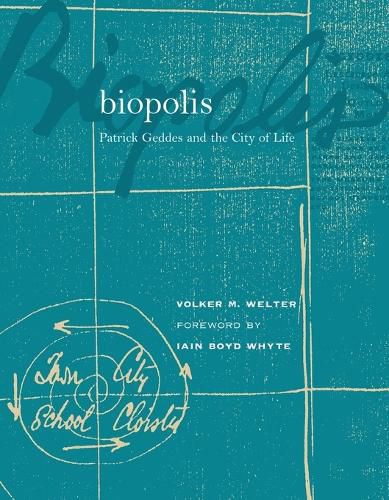
The Scottish urbanist and biologist Patrick Geddes (1854-1932) is perhaps best known for introducing the concept of region to architecture and planning. At the turn of the twentieth century, he was one of the strongest advocates of town planning and an active participant in debates about the future of the city. He was arguably the first planner to recognize the importance of historic city centers, and his renewal work in Edinburghi'1/2s Old Town is visible and impressive to this day.Geddes’s famous analytical triad–place, work, and folk, corresponding to the geographical, historical, and spiritual aspects of the city–provides the basic structure of this examination of his urban theory. Volker Welter examines Geddesi'1/2s ideas in the light of nineteenth-century biology–in which Geddes received his academic trainingi'½-showing Geddesi'1/2s use of biological concepts to be far more sophisticated than popular images of the city as an organic entity. His urbanism was informed by his lifelong interest in the theory of evolution and in ecology, cutting-edge areas in the late nineteenth century. Balancing Geddesi'1/2s biological thought is his interest in the historical Greek concept of polis, usually translated as city-state but implying a view of the city as a cultural and spiritual phenomenon.Although Geddesi'1/2s work was far-ranging, the city provided the unifying focus of nearly all of his theoretical and practical work. Throughout the book, Welter relates Geddesi'1/2s theory of the city to contemporary European debates about architecture and urbanism.
$9.00 standard shipping within Australia
FREE standard shipping within Australia for orders over $100.00
Express & International shipping calculated at checkout
Stock availability can be subject to change without notice. We recommend calling the shop or contacting our online team to check availability of low stock items. Please see our Shopping Online page for more details.
The Scottish urbanist and biologist Patrick Geddes (1854-1932) is perhaps best known for introducing the concept of region to architecture and planning. At the turn of the twentieth century, he was one of the strongest advocates of town planning and an active participant in debates about the future of the city. He was arguably the first planner to recognize the importance of historic city centers, and his renewal work in Edinburghi'1/2s Old Town is visible and impressive to this day.Geddes’s famous analytical triad–place, work, and folk, corresponding to the geographical, historical, and spiritual aspects of the city–provides the basic structure of this examination of his urban theory. Volker Welter examines Geddesi'1/2s ideas in the light of nineteenth-century biology–in which Geddes received his academic trainingi'½-showing Geddesi'1/2s use of biological concepts to be far more sophisticated than popular images of the city as an organic entity. His urbanism was informed by his lifelong interest in the theory of evolution and in ecology, cutting-edge areas in the late nineteenth century. Balancing Geddesi'1/2s biological thought is his interest in the historical Greek concept of polis, usually translated as city-state but implying a view of the city as a cultural and spiritual phenomenon.Although Geddesi'1/2s work was far-ranging, the city provided the unifying focus of nearly all of his theoretical and practical work. Throughout the book, Welter relates Geddesi'1/2s theory of the city to contemporary European debates about architecture and urbanism.
Search our extensive online catalogue.
