Readings Newsletter
Become a Readings Member to make your shopping experience even easier.
Sign in or sign up for free!
You’re not far away from qualifying for FREE standard shipping within Australia
You’ve qualified for FREE standard shipping within Australia
The cart is loading…


How Costa Rican leaders adopted policies to reduce planet-warming greenhouse gas emissions, and what other countries can learn from their actions.
How Costa Rican leaders adopted policies to reduce planet-warming greenhouse gas emissions, and what other countries can learn from their actions.
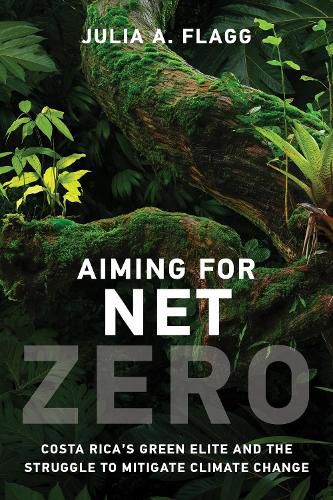
As atmospheric greenhouse gases continue their steep ascent, the world has never been more in need of policies designed to reduce emissions. Among those few nations that have committed to ambitious emission reduction plans is the small Central American country of Costa Rica, whose pioneering policies include a Payments for Environmental Services program, a carbon neutrality pledge, and a goal of decarbonizing the economy. In this book, Aiming for Net Zero, Julia Flagg explores why Costa Rican leaders have adopted more climate mitigation policies than leaders of other nations and how these leaders have introduced and developed these policies.
Drawing on archival evidence and interviews conducted between 2013 and 2021 with three dozen people who have contributed to climate policy in Costa Rica, Flagg tells the story of Costa Rica's climate mitigation policy development. Costa Rica's historically egalitarian class structure and interconnected, green-minded urban elite, she writes, prioritized investment in public welfare as the means to enhance the national level of development, leading to the advancement of climate mitigation policies during four historical moments- the late 1980s, the mid-1990s, the mid-2000s, and the late 2010s.
Offering many lessons for other nations aiming to curtail planet-warming emissions, Aiming for Net Zero shows how investments in the public good enhance social development-which, ultimately, allows state planners to pursue ambitious climate mitigation policies.
$9.00 standard shipping within Australia
FREE standard shipping within Australia for orders over $100.00
Express & International shipping calculated at checkout
Stock availability can be subject to change without notice. We recommend calling the shop or contacting our online team to check availability of low stock items. Please see our Shopping Online page for more details.
How Costa Rican leaders adopted policies to reduce planet-warming greenhouse gas emissions, and what other countries can learn from their actions.
How Costa Rican leaders adopted policies to reduce planet-warming greenhouse gas emissions, and what other countries can learn from their actions.
As atmospheric greenhouse gases continue their steep ascent, the world has never been more in need of policies designed to reduce emissions. Among those few nations that have committed to ambitious emission reduction plans is the small Central American country of Costa Rica, whose pioneering policies include a Payments for Environmental Services program, a carbon neutrality pledge, and a goal of decarbonizing the economy. In this book, Aiming for Net Zero, Julia Flagg explores why Costa Rican leaders have adopted more climate mitigation policies than leaders of other nations and how these leaders have introduced and developed these policies.
Drawing on archival evidence and interviews conducted between 2013 and 2021 with three dozen people who have contributed to climate policy in Costa Rica, Flagg tells the story of Costa Rica's climate mitigation policy development. Costa Rica's historically egalitarian class structure and interconnected, green-minded urban elite, she writes, prioritized investment in public welfare as the means to enhance the national level of development, leading to the advancement of climate mitigation policies during four historical moments- the late 1980s, the mid-1990s, the mid-2000s, and the late 2010s.
Offering many lessons for other nations aiming to curtail planet-warming emissions, Aiming for Net Zero shows how investments in the public good enhance social development-which, ultimately, allows state planners to pursue ambitious climate mitigation policies.
Search our extensive online catalogue.
