Readings Newsletter
Become a Readings Member to make your shopping experience even easier.
Sign in or sign up for free!
You’re not far away from qualifying for FREE standard shipping within Australia
You’ve qualified for FREE standard shipping within Australia
The cart is loading…


Tracing the cultural, material, and discursive history of an early manifestation of media culture in the making.
Tracing the cultural, material, and discursive history of an early manifestation of media culture in the making.
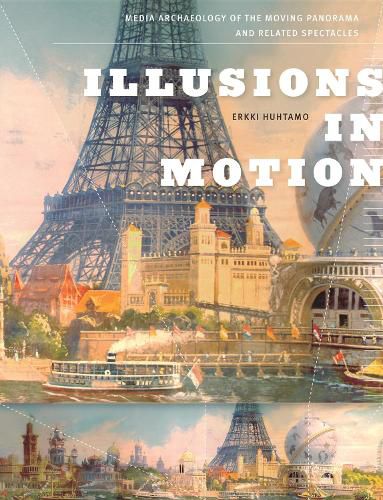
Beginning in the late eighteenth century, huge circular panoramas presented their audiences with resplendent representations that ranged from historic battles to exotic locations. Such panoramas were immersive but static. There were other panoramas that moved-hundreds, and probably thousands of them. Their history has been largely forgotten. In Illusions in Motion, Erkki Huhtamo excavates this neglected early manifestation of media culture in the making. The moving panorama was a long painting that unscrolled behind a "window" by means of a mechanical cranking system, accompanied by a lecture, music, and sometimes sound and light effects. Showmen exhibited such panoramas in venues that ranged from opera houses to church halls, creating a market for mediated realities in both city and country. In the first history of this phenomenon, Huhtamo analyzes the moving panorama in all its complexity, investigating its relationship to other media and its role in the culture of its time. In his telling, the panorama becomes a window for observing media in operation. Huhtamo explores such topics as cultural forms that anticipated the moving panorama; theatrical panoramas; the diorama; the "panoramania" of the 1850s and the career of Albert Smith, the most successful showman of that era; competition with magic lantern shows; the final flowering of the panorama in the late nineteenth century; and the panorama's afterlife as a topos, traced through its evocation in literature, journalism, science, philosophy, and propaganda.
$9.00 standard shipping within Australia
FREE standard shipping within Australia for orders over $100.00
Express & International shipping calculated at checkout
Stock availability can be subject to change without notice. We recommend calling the shop or contacting our online team to check availability of low stock items. Please see our Shopping Online page for more details.
Tracing the cultural, material, and discursive history of an early manifestation of media culture in the making.
Tracing the cultural, material, and discursive history of an early manifestation of media culture in the making.
Beginning in the late eighteenth century, huge circular panoramas presented their audiences with resplendent representations that ranged from historic battles to exotic locations. Such panoramas were immersive but static. There were other panoramas that moved-hundreds, and probably thousands of them. Their history has been largely forgotten. In Illusions in Motion, Erkki Huhtamo excavates this neglected early manifestation of media culture in the making. The moving panorama was a long painting that unscrolled behind a "window" by means of a mechanical cranking system, accompanied by a lecture, music, and sometimes sound and light effects. Showmen exhibited such panoramas in venues that ranged from opera houses to church halls, creating a market for mediated realities in both city and country. In the first history of this phenomenon, Huhtamo analyzes the moving panorama in all its complexity, investigating its relationship to other media and its role in the culture of its time. In his telling, the panorama becomes a window for observing media in operation. Huhtamo explores such topics as cultural forms that anticipated the moving panorama; theatrical panoramas; the diorama; the "panoramania" of the 1850s and the career of Albert Smith, the most successful showman of that era; competition with magic lantern shows; the final flowering of the panorama in the late nineteenth century; and the panorama's afterlife as a topos, traced through its evocation in literature, journalism, science, philosophy, and propaganda.
Search our extensive online catalogue.
