Readings Newsletter
Become a Readings Member to make your shopping experience even easier.
Sign in or sign up for free!
You’re not far away from qualifying for FREE standard shipping within Australia
You’ve qualified for FREE standard shipping within Australia
The cart is loading…


An overview of the theory and application of kernel classification methods.
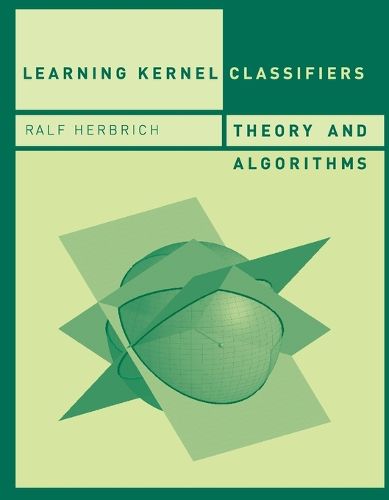
Linear classifiers in kernel spaces have emerged as a major topic within the field of machine learning. The kernel technique takes the linear classifier-a limited, but well-established and comprehensively studied model-and extends its applicability to a wide range of nonlinear pattern-recognition tasks such as natural language processing, machine vision, and biological sequence analysis. This book provides the first comprehensive overview of both the theory and algorithms of kernel classifiers, including the most recent developments. It begins by describing the major algorithmic advances: kernel perceptron learning, kernel Fisher discriminants, support vector machines, relevance vector machines, Gaussian processes, and Bayes point machines. Then follows a detailed introduction to learning theory, including VC and PAC-Bayesian theory, data-dependent structural risk minimization, and compression bounds. Throughout, the book emphasizes the interaction between theory and algorithms: how learning algorithms work and why. The book includes many examples, complete pseudo code of the algorithms presented, and an extensive source code library.
$9.00 standard shipping within Australia
FREE standard shipping within Australia for orders over $100.00
Express & International shipping calculated at checkout
Stock availability can be subject to change without notice. We recommend calling the shop or contacting our online team to check availability of low stock items. Please see our Shopping Online page for more details.
An overview of the theory and application of kernel classification methods.
Linear classifiers in kernel spaces have emerged as a major topic within the field of machine learning. The kernel technique takes the linear classifier-a limited, but well-established and comprehensively studied model-and extends its applicability to a wide range of nonlinear pattern-recognition tasks such as natural language processing, machine vision, and biological sequence analysis. This book provides the first comprehensive overview of both the theory and algorithms of kernel classifiers, including the most recent developments. It begins by describing the major algorithmic advances: kernel perceptron learning, kernel Fisher discriminants, support vector machines, relevance vector machines, Gaussian processes, and Bayes point machines. Then follows a detailed introduction to learning theory, including VC and PAC-Bayesian theory, data-dependent structural risk minimization, and compression bounds. Throughout, the book emphasizes the interaction between theory and algorithms: how learning algorithms work and why. The book includes many examples, complete pseudo code of the algorithms presented, and an extensive source code library.
Search our extensive online catalogue.
