Readings Newsletter
Become a Readings Member to make your shopping experience even easier.
Sign in or sign up for free!
You’re not far away from qualifying for FREE standard shipping within Australia
You’ve qualified for FREE standard shipping within Australia
The cart is loading…


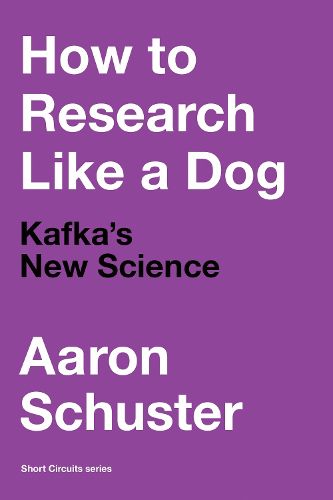
A provocative book that proposes a new and surprising inspiration for philosophy today-the canine thinker from Kafka's story "Investigations of a Dog."
A provocative book that proposes a new and surprising inspiration for philosophy today-the canine thinker from Kafka's story "Investigations of a Dog."
Written toward the end of Kafka's life, "Investigations of a Dog" (Forschungen eines Hundes, 1922) is one of the lesser-known and most enigmatic works in the author's oeuvre. Kafka's tale of philosophical adventure is that of a lone, maladjusted dog who challenges the dogmatism of established science and pioneers an original research program in pursuit of the mysteries of his self and his world. In How to Research Like a Dog, Aaron Schuster uses the canine as a guide dog to rediscover Kafka's fictional universe, while taking up the cause of this ingenious, possessed, melancholy, comical, and revolutionary thinker.
Neither an exercise in literary criticism nor a traditional philosophical commentary, this charming and idiosyncratic book aligns itself with the research program of Kafka's dog. It constructs an "impossible" system based on the fourfold division of nourishment, music, incantation, and freedom-or, stated a bit differently- enjoyment, art, institutions, and freedom. From Plato to Flaubert, Lispector, and Lacan, Schuster puts the dog in dialogue with psychoanalytic theory, the history of philosophy, and modern literature. Imagining the "Unknown University" that Kafka's new science calls for, the book enlists new comrades in the dog's struggle.
$9.00 standard shipping within Australia
FREE standard shipping within Australia for orders over $100.00
Express & International shipping calculated at checkout
Stock availability can be subject to change without notice. We recommend calling the shop or contacting our online team to check availability of low stock items. Please see our Shopping Online page for more details.
A provocative book that proposes a new and surprising inspiration for philosophy today-the canine thinker from Kafka's story "Investigations of a Dog."
A provocative book that proposes a new and surprising inspiration for philosophy today-the canine thinker from Kafka's story "Investigations of a Dog."
Written toward the end of Kafka's life, "Investigations of a Dog" (Forschungen eines Hundes, 1922) is one of the lesser-known and most enigmatic works in the author's oeuvre. Kafka's tale of philosophical adventure is that of a lone, maladjusted dog who challenges the dogmatism of established science and pioneers an original research program in pursuit of the mysteries of his self and his world. In How to Research Like a Dog, Aaron Schuster uses the canine as a guide dog to rediscover Kafka's fictional universe, while taking up the cause of this ingenious, possessed, melancholy, comical, and revolutionary thinker.
Neither an exercise in literary criticism nor a traditional philosophical commentary, this charming and idiosyncratic book aligns itself with the research program of Kafka's dog. It constructs an "impossible" system based on the fourfold division of nourishment, music, incantation, and freedom-or, stated a bit differently- enjoyment, art, institutions, and freedom. From Plato to Flaubert, Lispector, and Lacan, Schuster puts the dog in dialogue with psychoanalytic theory, the history of philosophy, and modern literature. Imagining the "Unknown University" that Kafka's new science calls for, the book enlists new comrades in the dog's struggle.
Search our extensive online catalogue.
