Readings Newsletter
Become a Readings Member to make your shopping experience even easier.
Sign in or sign up for free!
You’re not far away from qualifying for FREE standard shipping within Australia
You’ve qualified for FREE standard shipping within Australia
The cart is loading…


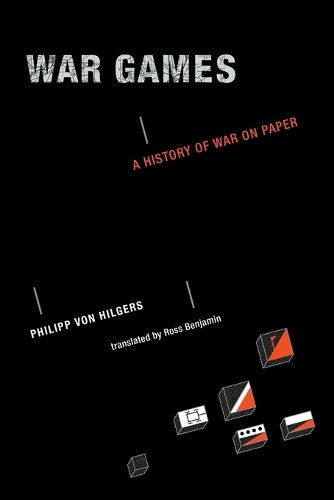
The convergence of military strategy and mathematics in war games, from medieval to modern times.
For centuries, both mathematical and military thinkers have used game-like scenarios to test their visions of mastering a complex world through symbolic operations. By the end of World War I, mathematical and military discourse in Germany simultaneously discovered the game as a productive concept. Mathematics and military strategy converged in World War II when mathematicians designed fields of operation. In this book, Philipp von Hilgers examines the theory and practice of war games through history, from the medieval game boards, captured on parchment, to the paper map exercises of the Third Reich. Von Hilgers considers how and why war games came to exist: why mathematical and military thinkers created simulations of one of the most unpredictable human activities on earth.
Von Hilgers begins with the medieval rythmomachia, or Battle of Numbers, then reconstructs the ideas about war and games in the baroque period. He investigates the role of George Leopold von Reiswitz’s tactical war game in nineteenth-century Prussia and describes the artifact itself: a game board-topped table with drawers for game implements. He explains Clausewitz’s emphasis on the fog of war and the accompanying element of incalculability, examines the contributions of such thinkers as Clausewitz, Leibniz, Wittgenstein, and von Neumann, and investigates the war games of the German military between the two World Wars. Baudrillard declared this to be the age of simulacra; war games stand contrariwise as simulations that have not been subsumed in absolute virtuality.
$9.00 standard shipping within Australia
FREE standard shipping within Australia for orders over $100.00
Express & International shipping calculated at checkout
Stock availability can be subject to change without notice. We recommend calling the shop or contacting our online team to check availability of low stock items. Please see our Shopping Online page for more details.
The convergence of military strategy and mathematics in war games, from medieval to modern times.
For centuries, both mathematical and military thinkers have used game-like scenarios to test their visions of mastering a complex world through symbolic operations. By the end of World War I, mathematical and military discourse in Germany simultaneously discovered the game as a productive concept. Mathematics and military strategy converged in World War II when mathematicians designed fields of operation. In this book, Philipp von Hilgers examines the theory and practice of war games through history, from the medieval game boards, captured on parchment, to the paper map exercises of the Third Reich. Von Hilgers considers how and why war games came to exist: why mathematical and military thinkers created simulations of one of the most unpredictable human activities on earth.
Von Hilgers begins with the medieval rythmomachia, or Battle of Numbers, then reconstructs the ideas about war and games in the baroque period. He investigates the role of George Leopold von Reiswitz’s tactical war game in nineteenth-century Prussia and describes the artifact itself: a game board-topped table with drawers for game implements. He explains Clausewitz’s emphasis on the fog of war and the accompanying element of incalculability, examines the contributions of such thinkers as Clausewitz, Leibniz, Wittgenstein, and von Neumann, and investigates the war games of the German military between the two World Wars. Baudrillard declared this to be the age of simulacra; war games stand contrariwise as simulations that have not been subsumed in absolute virtuality.
Search our extensive online catalogue.
