Readings Newsletter
Become a Readings Member to make your shopping experience even easier.
Sign in or sign up for free!
You’re not far away from qualifying for FREE standard shipping within Australia
You’ve qualified for FREE standard shipping within Australia
The cart is loading…


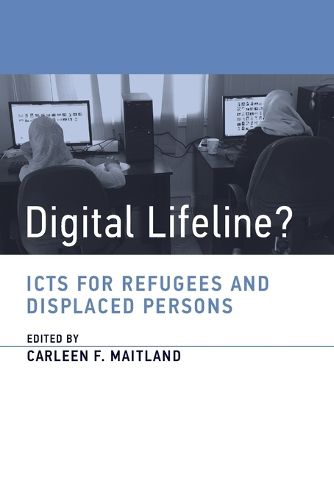
Interdisciplinary perspectives on the role of new information technologies, including mobile phones, wireless networks, and biometric identification, in the global refugee crisis.Today’s global refugee crisis has mobilized humanitarian efforts to help those fleeing persecution and armed conflict at all stages of their journey. Aid organizations are increasingly employing new information technologies in their mission, taking advantage of proliferating mobile phones, remote sensors, wireless networks, and biometric identification systems. Digital Lifeline? examines the use of these technological innovations by the humanitarian community, exploring operations and systems that range from forecasting refugee flows to providing cellular and Internet connectivity to displaced persons. The contributors, from disciplines as diverse as international law and computer science, offer a variety of perspectives on forced migration, technical development, and user behavior, drawing on field work in countries including Jordan, Lebanon, Rwanda, Germany, Greece, the United States, and Canada.
The chapters consider such topics as the use of information technology in refugee status determination; ethical and legal issues surrounding biometric technologies; information technology within organizational hierarchies; the use of technology by refugees; access issues in refugee camps; the scalability and sustainability of information technology innovations in humanitarian work; geographic information systems and spatial thinking; and the use of big data analytic techniques. Finally, the book identifies policy research directions, develops a unified research agenda, and offers practical suggestions for conducting displacement research. Contributors Elizabeth Belding, Karen E. Fisher, Daniel Iland, Lindsey N. Kingston, Carleen F. Maitland, Susan F. Martin, Galya Ben-Arieh Ruffer, Paul Schmitt, Lisa Singh, Brian Tomaszewski, Mariya Zheleva
$9.00 standard shipping within Australia
FREE standard shipping within Australia for orders over $100.00
Express & International shipping calculated at checkout
Stock availability can be subject to change without notice. We recommend calling the shop or contacting our online team to check availability of low stock items. Please see our Shopping Online page for more details.
Interdisciplinary perspectives on the role of new information technologies, including mobile phones, wireless networks, and biometric identification, in the global refugee crisis.Today’s global refugee crisis has mobilized humanitarian efforts to help those fleeing persecution and armed conflict at all stages of their journey. Aid organizations are increasingly employing new information technologies in their mission, taking advantage of proliferating mobile phones, remote sensors, wireless networks, and biometric identification systems. Digital Lifeline? examines the use of these technological innovations by the humanitarian community, exploring operations and systems that range from forecasting refugee flows to providing cellular and Internet connectivity to displaced persons. The contributors, from disciplines as diverse as international law and computer science, offer a variety of perspectives on forced migration, technical development, and user behavior, drawing on field work in countries including Jordan, Lebanon, Rwanda, Germany, Greece, the United States, and Canada.
The chapters consider such topics as the use of information technology in refugee status determination; ethical and legal issues surrounding biometric technologies; information technology within organizational hierarchies; the use of technology by refugees; access issues in refugee camps; the scalability and sustainability of information technology innovations in humanitarian work; geographic information systems and spatial thinking; and the use of big data analytic techniques. Finally, the book identifies policy research directions, develops a unified research agenda, and offers practical suggestions for conducting displacement research. Contributors Elizabeth Belding, Karen E. Fisher, Daniel Iland, Lindsey N. Kingston, Carleen F. Maitland, Susan F. Martin, Galya Ben-Arieh Ruffer, Paul Schmitt, Lisa Singh, Brian Tomaszewski, Mariya Zheleva
Search our extensive online catalogue.
