Readings Newsletter
Become a Readings Member to make your shopping experience even easier.
Sign in or sign up for free!
You’re not far away from qualifying for FREE standard shipping within Australia
You’ve qualified for FREE standard shipping within Australia
The cart is loading…


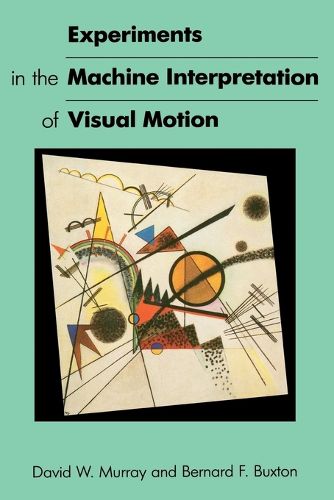
This book describes experimental advances made in the interpretation of visual motion over the last few years that have moved researchers closer to emulating the way in which we recover information about the surrounding world.
If robots are to act intelligently in everyday environments, they must have a perception of motion and its consequences. This book describes experimental advances made in the interpretation of visual motion over the last few years that have moved researchers closer to emulating the way in which we recover information about the surrounding world. It describes algorithms that form a complete, implemented, and tested system developed by the authors to measure two-dimensional motion in an image sequence, then to compute three-dimensional structure and motion, and finally to recognize the moving objects.
The authors develop algorithms to interpret visual motion around four principal constraints. The first and simplest allows the scene structure to be recovered on a pointwise basis. The second constrains the scene to a set of connected straight edges. The third makes the transition between edge and surface representations by demanding that the wireframe recovered is strictly polyhedral. And the final constraint assumes that the scene is comprised of planar surfaces, and recovers them directly.
Contents Image, Scene, and Motion * Computing Image Motion * Structure from Motion of Points * The Structure and Motion of Edges * From Edges to Surfaces * Structure and Motion of Planes * Visual Motion Segmentation * Matching to Edge Models * Matching to Planar Surfaces
$9.00 standard shipping within Australia
FREE standard shipping within Australia for orders over $100.00
Express & International shipping calculated at checkout
Stock availability can be subject to change without notice. We recommend calling the shop or contacting our online team to check availability of low stock items. Please see our Shopping Online page for more details.
This book describes experimental advances made in the interpretation of visual motion over the last few years that have moved researchers closer to emulating the way in which we recover information about the surrounding world.
If robots are to act intelligently in everyday environments, they must have a perception of motion and its consequences. This book describes experimental advances made in the interpretation of visual motion over the last few years that have moved researchers closer to emulating the way in which we recover information about the surrounding world. It describes algorithms that form a complete, implemented, and tested system developed by the authors to measure two-dimensional motion in an image sequence, then to compute three-dimensional structure and motion, and finally to recognize the moving objects.
The authors develop algorithms to interpret visual motion around four principal constraints. The first and simplest allows the scene structure to be recovered on a pointwise basis. The second constrains the scene to a set of connected straight edges. The third makes the transition between edge and surface representations by demanding that the wireframe recovered is strictly polyhedral. And the final constraint assumes that the scene is comprised of planar surfaces, and recovers them directly.
Contents Image, Scene, and Motion * Computing Image Motion * Structure from Motion of Points * The Structure and Motion of Edges * From Edges to Surfaces * Structure and Motion of Planes * Visual Motion Segmentation * Matching to Edge Models * Matching to Planar Surfaces
Search our extensive online catalogue.
