Readings Newsletter
Become a Readings Member to make your shopping experience even easier.
Sign in or sign up for free!
You’re not far away from qualifying for FREE standard shipping within Australia
You’ve qualified for FREE standard shipping within Australia
The cart is loading…


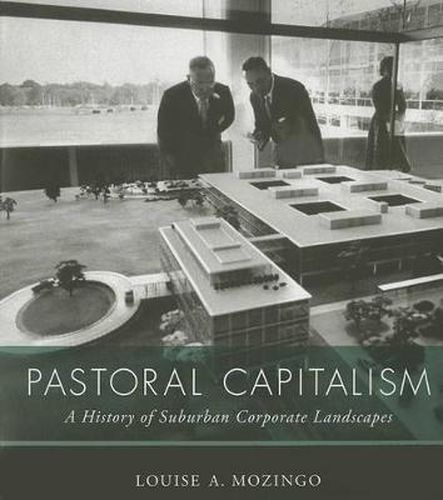
How business appropriated the pastoral landscape, as seen in the corporate campus, the corporate estate, and the office park.
By the end of the twentieth century, America’s suburbs contained more office space than its central cities. Many of these corporate workplaces were surrounded, somewhat incongruously, by verdant vistas of broad lawns and leafy trees. In Pastoral Capitalism, Louise Mozingo describes the evolution of these central (but often ignored) features of postwar urbanism in the context of the modern capitalist enterprise.
These new suburban corporate landscapes emerged from a historical moment when corporations reconceived their management structures, the city decentralized and dispersed into low-density, auto-dependent peripheries, and the pastoral-in the form of leafy residential suburbs-triumphed as an American ideal. Greenness, writes Mozingo, was associated with goodness, and pastoral capitalism appropriated the suburb’s aesthetics and moral code. Like the lawn-proud suburban homeowner, corporations understood a pastoral landscape’s capacity to communicate identity, status, and right-mindedness.
Mozingo distinguishes among three forms of corporate landscapes-the corporate campus, the corporate estate, and the office park-and examines suburban corporate landscapes built and inhabited by such companies as Bell Labs, General Motors, Deere & Company, and Microsoft. She also considers the globalization of pastoral capitalism in Europe and the developing world including Singapore, India, and China. Mozingo argues that, even as it is proliferating, pastoral capitalism needs redesign, as do many of our metropolitan forms, for pressing social, cultural, political, and environmental reasons. Future transformations are impossible, however, unless we understand the past. Pastoral Capitalism offers an indispensible chapter in urban history, examining not only the design of corporate landscapes but also the economic, social, and cultural models that determined their form.
$9.00 standard shipping within Australia
FREE standard shipping within Australia for orders over $100.00
Express & International shipping calculated at checkout
Stock availability can be subject to change without notice. We recommend calling the shop or contacting our online team to check availability of low stock items. Please see our Shopping Online page for more details.
How business appropriated the pastoral landscape, as seen in the corporate campus, the corporate estate, and the office park.
By the end of the twentieth century, America’s suburbs contained more office space than its central cities. Many of these corporate workplaces were surrounded, somewhat incongruously, by verdant vistas of broad lawns and leafy trees. In Pastoral Capitalism, Louise Mozingo describes the evolution of these central (but often ignored) features of postwar urbanism in the context of the modern capitalist enterprise.
These new suburban corporate landscapes emerged from a historical moment when corporations reconceived their management structures, the city decentralized and dispersed into low-density, auto-dependent peripheries, and the pastoral-in the form of leafy residential suburbs-triumphed as an American ideal. Greenness, writes Mozingo, was associated with goodness, and pastoral capitalism appropriated the suburb’s aesthetics and moral code. Like the lawn-proud suburban homeowner, corporations understood a pastoral landscape’s capacity to communicate identity, status, and right-mindedness.
Mozingo distinguishes among three forms of corporate landscapes-the corporate campus, the corporate estate, and the office park-and examines suburban corporate landscapes built and inhabited by such companies as Bell Labs, General Motors, Deere & Company, and Microsoft. She also considers the globalization of pastoral capitalism in Europe and the developing world including Singapore, India, and China. Mozingo argues that, even as it is proliferating, pastoral capitalism needs redesign, as do many of our metropolitan forms, for pressing social, cultural, political, and environmental reasons. Future transformations are impossible, however, unless we understand the past. Pastoral Capitalism offers an indispensible chapter in urban history, examining not only the design of corporate landscapes but also the economic, social, and cultural models that determined their form.
Search our extensive online catalogue.
