Readings Newsletter
Become a Readings Member to make your shopping experience even easier.
Sign in or sign up for free!
You’re not far away from qualifying for FREE standard shipping within Australia
You’ve qualified for FREE standard shipping within Australia
The cart is loading…


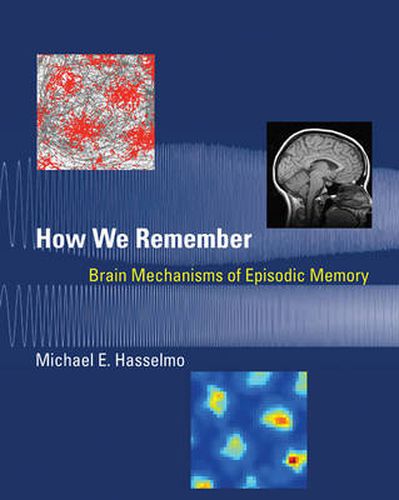
A novel perspective on the biological mechanisms of episodic memory, focusing on the encoding and retrieval of spatiotemporal trajectories.Episodic memory proves essential for daily function, allowing us to remember where we parked the car, what time we walked the dog, or what a friend said earlier. In How We Remember, Michael Hasselmo draws on recent developments in neuroscience to present a new model describing the brain mechanisms for encoding and remembering such events as spatiotemporal trajectories. He reviews physiological breakthroughs on the regions implicated in episodic memory, including the discovery of grid cells, the cellular mechanisms of persistent spiking and resonant frequency, and the topographic coding of space and time. These discoveries inspire a theory for understanding the encoding and retrieval of episodic memory not just as discrete snapshots but as a dynamic replay of spatiotemporal trajectories, allowing us to retrace our steps to recover a memory. In the main text of the book, he presents the model in narrative form, accessible to scholars and advanced undergraduates in many fields. In the appendix, he presents the material in a more quantitative style, providing mathematical descriptions appropriate for advanced undergraduates and graduate students in neuroscience or engineering.
$9.00 standard shipping within Australia
FREE standard shipping within Australia for orders over $100.00
Express & International shipping calculated at checkout
Stock availability can be subject to change without notice. We recommend calling the shop or contacting our online team to check availability of low stock items. Please see our Shopping Online page for more details.
A novel perspective on the biological mechanisms of episodic memory, focusing on the encoding and retrieval of spatiotemporal trajectories.Episodic memory proves essential for daily function, allowing us to remember where we parked the car, what time we walked the dog, or what a friend said earlier. In How We Remember, Michael Hasselmo draws on recent developments in neuroscience to present a new model describing the brain mechanisms for encoding and remembering such events as spatiotemporal trajectories. He reviews physiological breakthroughs on the regions implicated in episodic memory, including the discovery of grid cells, the cellular mechanisms of persistent spiking and resonant frequency, and the topographic coding of space and time. These discoveries inspire a theory for understanding the encoding and retrieval of episodic memory not just as discrete snapshots but as a dynamic replay of spatiotemporal trajectories, allowing us to retrace our steps to recover a memory. In the main text of the book, he presents the model in narrative form, accessible to scholars and advanced undergraduates in many fields. In the appendix, he presents the material in a more quantitative style, providing mathematical descriptions appropriate for advanced undergraduates and graduate students in neuroscience or engineering.
Search our extensive online catalogue.
