Readings Newsletter
Become a Readings Member to make your shopping experience even easier.
Sign in or sign up for free!
You’re not far away from qualifying for FREE standard shipping within Australia
You’ve qualified for FREE standard shipping within Australia
The cart is loading…


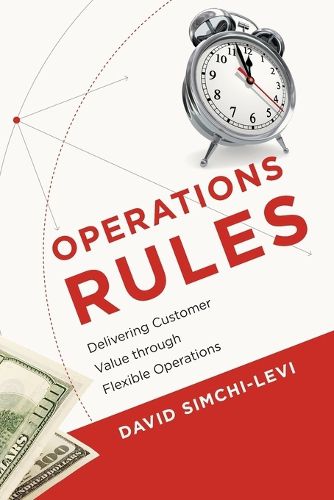
An expert offers a set of rules that will help managers achieve dramatic improvements in operations performance.
In recent years, management gurus have urged businesses to adopt such strategies as just-in-time, lean manufacturing, offshoring, and frequent deliveries to retail outlets. But today, these much-touted strategies may be risky. Global financial turmoil, rising labor costs in developing countries, and huge volatility in the price of oil and other commodities can disrupt a company’s entire supply chain and threaten its ability to compete. In Operations Rules, David Simchi-Levi identifies the crucial element in a company’s success: the link between the value it provides its customers and its operations strategies. And he offers a set of scientifically and empirically based rules that management can follow to achieve a quantum leap in operations performance.
Flexibility, says Simchi-Levi, is the single most important capability that allows firms to innovate in their operations and supply chain strategies. A small investment in flexibility can achieve almost all the benefits of full flexibility. And successful companies do not all pursue the same strategies. Amazon and Wal-Mart, for example, are direct competitors but each focuses on a different market channel and provides a unique customer value proposition-Amazon, large selection and reliable fulfillment; Wal-Mart, low prices-that directly aligns with its operations strategy. Simchi-Levi’s rules-regarding such issues as channels, price, product characteristics, value-added service, procurement strategy, and information technolog–transform operations and supply chain management from an undertaking based on gut feeling and anecdotes to a science.
$9.00 standard shipping within Australia
FREE standard shipping within Australia for orders over $100.00
Express & International shipping calculated at checkout
Stock availability can be subject to change without notice. We recommend calling the shop or contacting our online team to check availability of low stock items. Please see our Shopping Online page for more details.
An expert offers a set of rules that will help managers achieve dramatic improvements in operations performance.
In recent years, management gurus have urged businesses to adopt such strategies as just-in-time, lean manufacturing, offshoring, and frequent deliveries to retail outlets. But today, these much-touted strategies may be risky. Global financial turmoil, rising labor costs in developing countries, and huge volatility in the price of oil and other commodities can disrupt a company’s entire supply chain and threaten its ability to compete. In Operations Rules, David Simchi-Levi identifies the crucial element in a company’s success: the link between the value it provides its customers and its operations strategies. And he offers a set of scientifically and empirically based rules that management can follow to achieve a quantum leap in operations performance.
Flexibility, says Simchi-Levi, is the single most important capability that allows firms to innovate in their operations and supply chain strategies. A small investment in flexibility can achieve almost all the benefits of full flexibility. And successful companies do not all pursue the same strategies. Amazon and Wal-Mart, for example, are direct competitors but each focuses on a different market channel and provides a unique customer value proposition-Amazon, large selection and reliable fulfillment; Wal-Mart, low prices-that directly aligns with its operations strategy. Simchi-Levi’s rules-regarding such issues as channels, price, product characteristics, value-added service, procurement strategy, and information technolog–transform operations and supply chain management from an undertaking based on gut feeling and anecdotes to a science.
Search our extensive online catalogue.
