Readings Newsletter
Become a Readings Member to make your shopping experience even easier.
Sign in or sign up for free!
You’re not far away from qualifying for FREE standard shipping within Australia
You’ve qualified for FREE standard shipping within Australia
The cart is loading…


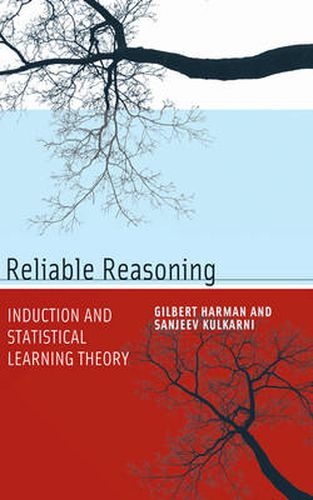
In Reliable Reasoning, Gilbert Harman and Sanjeev Kulkarni–a philosopher and an engineer–argue that philosophy and cognitive science can benefit from statistical learning theory (SLT), the theory that lies behind recent advances in machine learning. The philosophical problem of induction, for example, is in part about the reliability of inductive reasoning, where the reliability of a method is measured by its statistically expected percentage of errors–a central topic in SLT. After discussing philosophical attempts to evade the problem of induction, Harman and Kulkarni provide an admirably clear account of the basic framework of SLT and its implications for inductive reasoning. They explain the Vapnik-Chervonenkis (VC) dimension of a set of hypotheses and distinguish two kinds of inductive reasoning. The authors discuss various topics in machine learning, including nearest-neighbor methods, neural networks, and support vector machines. Finally, they describe transductive reasoning and suggest possible new models of human reasoning suggested by developments in SLT.
$9.00 standard shipping within Australia
FREE standard shipping within Australia for orders over $100.00
Express & International shipping calculated at checkout
Stock availability can be subject to change without notice. We recommend calling the shop or contacting our online team to check availability of low stock items. Please see our Shopping Online page for more details.
In Reliable Reasoning, Gilbert Harman and Sanjeev Kulkarni–a philosopher and an engineer–argue that philosophy and cognitive science can benefit from statistical learning theory (SLT), the theory that lies behind recent advances in machine learning. The philosophical problem of induction, for example, is in part about the reliability of inductive reasoning, where the reliability of a method is measured by its statistically expected percentage of errors–a central topic in SLT. After discussing philosophical attempts to evade the problem of induction, Harman and Kulkarni provide an admirably clear account of the basic framework of SLT and its implications for inductive reasoning. They explain the Vapnik-Chervonenkis (VC) dimension of a set of hypotheses and distinguish two kinds of inductive reasoning. The authors discuss various topics in machine learning, including nearest-neighbor methods, neural networks, and support vector machines. Finally, they describe transductive reasoning and suggest possible new models of human reasoning suggested by developments in SLT.
Search our extensive online catalogue.
