Readings Newsletter
Become a Readings Member to make your shopping experience even easier.
Sign in or sign up for free!
You’re not far away from qualifying for FREE standard shipping within Australia
You’ve qualified for FREE standard shipping within Australia
The cart is loading…


Literature and neuroscience come together to illuminate the human experience of beauty, which unfolds in time.
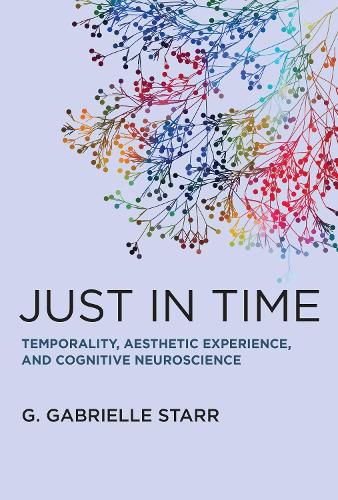
How does beauty exist in time? This is Gabrielle Starr’s central concern in Just in Time as she explores the experience of beauty not as an abstraction, but as the result of psychological and neurological processes in which time is central. Starr shows that aesthetic experience has temporal scale. Starr, a literary scholar and pioneer in the field and method of neuroaesthetics, which seeks the neurological basis of aesthetic experience, applies this methodology to the study of beauty in literature, considering such authors as Dawoud Bey, Rita Dove, Gerard Manley Hopkins, Henry James, Toni Morrison, and Wallace Stevens, as well as the artist Jasper Johns.
Just in Time is richly informed by the methods and findings of neuroscientists, whose instruments let them investigate encounters with art down to the millisecond, but Starr goes beyond the laboratory to explore engagements with art that unfold over durations experiments cannot accommodate. In neuroaesthetics, Starr shows us, the techniques of the empirical sciences and humanistic interpretation support and complement one another. To understand the temporal quality of aesthetic experience we need both cognitive and phenomenological approaches, and this book moves boldly toward their synthesis.
$9.00 standard shipping within Australia
FREE standard shipping within Australia for orders over $100.00
Express & International shipping calculated at checkout
Stock availability can be subject to change without notice. We recommend calling the shop or contacting our online team to check availability of low stock items. Please see our Shopping Online page for more details.
Literature and neuroscience come together to illuminate the human experience of beauty, which unfolds in time.
How does beauty exist in time? This is Gabrielle Starr’s central concern in Just in Time as she explores the experience of beauty not as an abstraction, but as the result of psychological and neurological processes in which time is central. Starr shows that aesthetic experience has temporal scale. Starr, a literary scholar and pioneer in the field and method of neuroaesthetics, which seeks the neurological basis of aesthetic experience, applies this methodology to the study of beauty in literature, considering such authors as Dawoud Bey, Rita Dove, Gerard Manley Hopkins, Henry James, Toni Morrison, and Wallace Stevens, as well as the artist Jasper Johns.
Just in Time is richly informed by the methods and findings of neuroscientists, whose instruments let them investigate encounters with art down to the millisecond, but Starr goes beyond the laboratory to explore engagements with art that unfold over durations experiments cannot accommodate. In neuroaesthetics, Starr shows us, the techniques of the empirical sciences and humanistic interpretation support and complement one another. To understand the temporal quality of aesthetic experience we need both cognitive and phenomenological approaches, and this book moves boldly toward their synthesis.
Search our extensive online catalogue.
