Readings Newsletter
Become a Readings Member to make your shopping experience even easier.
Sign in or sign up for free!
You’re not far away from qualifying for FREE standard shipping within Australia
You’ve qualified for FREE standard shipping within Australia
The cart is loading…


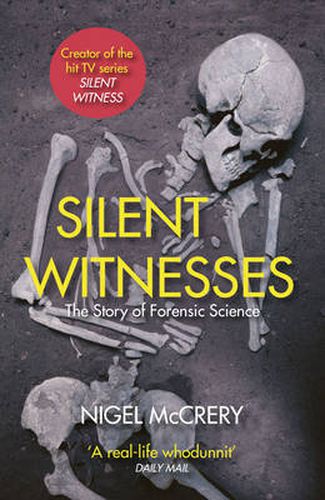
A gripping history of forensic science by the creator of the BBC series Silent Witness
A crime scene. A murder. A mystery.
The most important person on the scene? The forensic scientist. And yet the intricate details of their work remains a mystery to most of us.
Silent Witnesses looks at the history of forensic science over the last two centuries, during which time a combination of remarkable intuition, painstaking observation and leaps in scientific knowledge have developed this fascinating branch of detection. Throwing open the casebook, it introduces us to such luminaries as ‘The Wizard of Berkeley’ Edward Heinrich, who is credited with having solved over 2000 crimes, and Alphonse Bertillon, the French scientist whose guiding principle ‘no two individuals share the same characteristics’ became the core of identification. Along the way, it takes us to India and Australia, Columbia and China, Russia, France, Germany, Spain and Italy. And it proves that, in order to solve ever more complicated cases, science must always stay one step ahead of the killer.
$9.00 standard shipping within Australia
FREE standard shipping within Australia for orders over $100.00
Express & International shipping calculated at checkout
Stock availability can be subject to change without notice. We recommend calling the shop or contacting our online team to check availability of low stock items. Please see our Shopping Online page for more details.
A gripping history of forensic science by the creator of the BBC series Silent Witness
A crime scene. A murder. A mystery.
The most important person on the scene? The forensic scientist. And yet the intricate details of their work remains a mystery to most of us.
Silent Witnesses looks at the history of forensic science over the last two centuries, during which time a combination of remarkable intuition, painstaking observation and leaps in scientific knowledge have developed this fascinating branch of detection. Throwing open the casebook, it introduces us to such luminaries as ‘The Wizard of Berkeley’ Edward Heinrich, who is credited with having solved over 2000 crimes, and Alphonse Bertillon, the French scientist whose guiding principle ‘no two individuals share the same characteristics’ became the core of identification. Along the way, it takes us to India and Australia, Columbia and China, Russia, France, Germany, Spain and Italy. And it proves that, in order to solve ever more complicated cases, science must always stay one step ahead of the killer.
Search our extensive online catalogue.
